Showing posts with label Universal Esperanto Association. Show all posts

Sunday, December 10, 2023

Human Rights Day and Zamenhof Day posters in Indian languages

Source: Esperanto
Por UN
December 10, 2023 is the 75th anniversary of the Universal Declaration of Human Rights (UDHR). Five days later, December 15, is Zamenhof Day, which celebrates the birth anniversary of the founder of Esperanto, L. L. Zamenhof. This year, the Universal Esperanto Association (UEA) has linked the two in a campaign, Digno, Libereco kaj Justeco por ĉiuj homoj kaj ĉiuj lingvoj ("Dignity, Freedom and Justice for all people and all languages").

As UEA notes in the English translation of its message (PDF), "Respect for human rights was specifically written into the UEA’s Constitution even before the formal establishment of the Declaration." Esperanto Por UN, an Esperanto-language support organisation for the United Nations, has also designed a poster as part of this campaign. Humphrey Tonkin, Renato Corsetti, and Rafael Lima have coordinated the campaign.

Esperantists (and friends of Esperanto!) in India collaborated to rapidly produce the poster in eight languages: Bengali, Hindi, Kannada, Malayalam, Odia, Punjabi, Tamil, and Telugu. Earlier in 2023, we had blogged about a similar collaboration on colourful posters for the International Mother Language Day (IMLD).

A big Dankon! to friends in Hyderabad, Pune, and Shillong, and at Dialogo, the Esperanto-Klubo at Azim Premji University, for the translations! We hope the campaign will further underline UEA's message that, "Full human rights include linguistic human rights, which should form a basis for reciprocal respect and cooperation."

The message and the posters have been translated into several languages and are archived here. And here are the Esperanto original, and the translations by the Indian group:

 
Esperanto. Source:
Esperanto Por UN
Bengali.
Tr: Sajal Dey
 
Kannada.
Tr: S S Pradhan

 
Malayalam. Tr:
Mehajabin Nargees MP

 
Odia.
Tr: Amalendu Jyotishi

 
Punjabi. Tr:
Harjinder Singh Laltu

 
Tamil.
Tr. P. Arul Nehru

 
Telugu. Tr:
Kotha Naga Siva Kumar

 
Assamese.
Tr: Nazrul Haque


Saturday, February 18, 2023

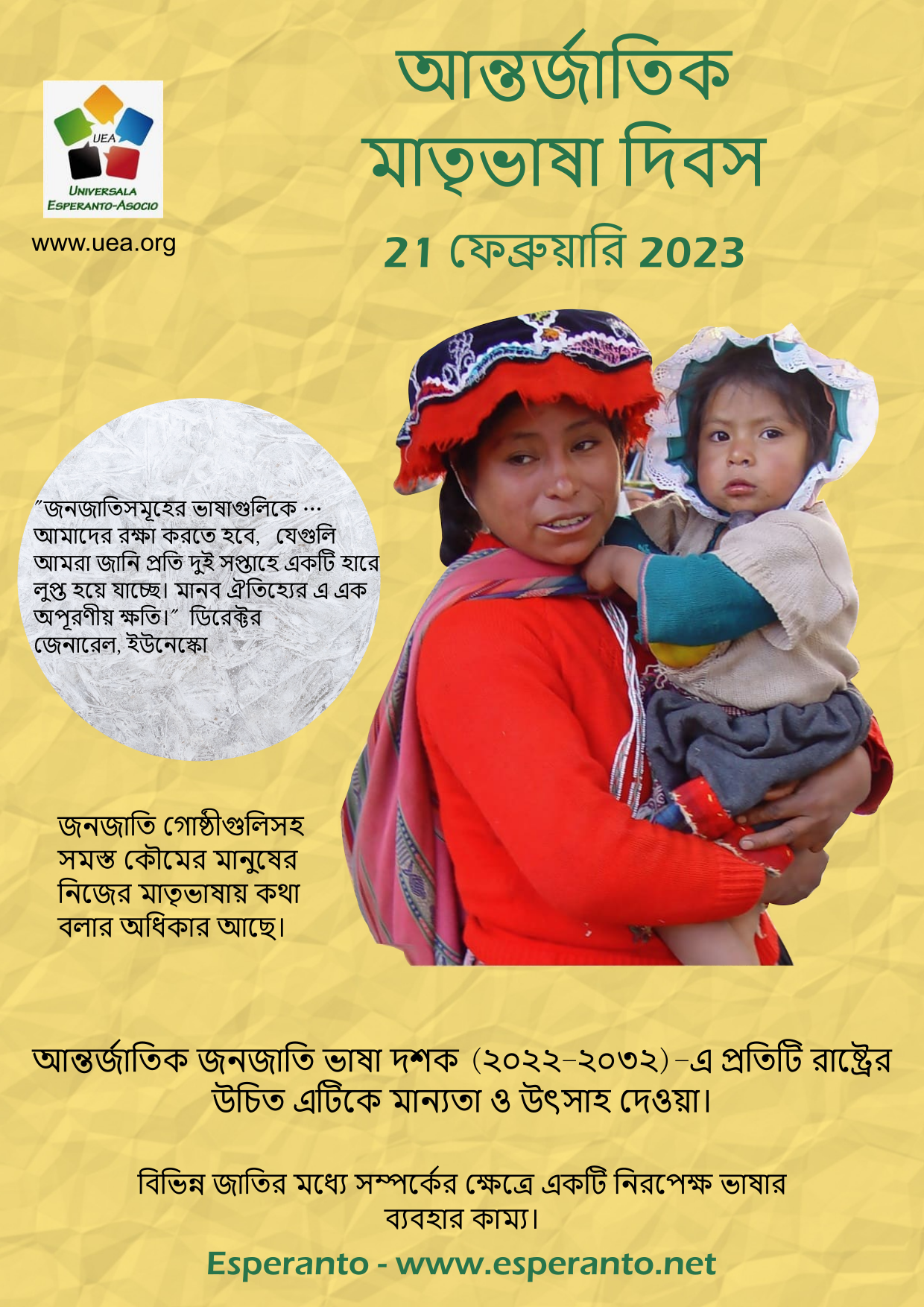
International Mother Language Day Posters

UEA IMLD 2023 poster.
Designed by Stefano Keller.
Tr. A. Giridhar Rao.
February 21st is International Mother Language Day (IMLD). Universala Esperanto Association (UEA) produces a poster every year to mark the event. Stefano Keller in Geneva designed this year's colourful poster. For several years now, Renato Corsetti in London has been getting Esperantists to translate the text of the poster into various languages. Posters from previous years are archived on the multilingual website Linguistic Rights.

This year too, Esperantists (and friends of Esperanto!) in India and Kenya produced texts in several languages. Rafael Lima in New York rapidly incorporated the text into Stefano's poster. Here is a gallery of those posters in Assamese, Bengali, English, Esperanto, Gujarati, Hindi, Kannada, Luo, Malayalam, Marathi, Odia, Punjabi, Sanskrit, Swahili, Tamil, and Telugu!


UEA IMLD 2023 poster in Assamese.
Designed by Stefano Keller.
Tr. Nazrul Haque


UEA IMLD 2023 poster in Bengali.
Designed by Stefano Keller.
Tr. Sajal Dey.

UEA IMLD 2023 poster in Esperanto.
Designed by Stefano Keller.


UEA IMLD 2023 poster in Gujarati.
Designed by Stefano Keller.
Tr. Himanshu Upadhyaya.

UEA IMLD 2023 poster in Hindi.
Designed by Stefano Keller.
Tr. Harjinder Singh Laltu.

UEA IMLD 2023 poster in Kannada.
Designed by Stefano Keller.
Tr. S S Pradhan.

UEA IMLD 2023 poster in Luo.
Designed by Stefano Keller.
Tr. Abado Jack Mtulla, Abado Joseph Mtulla.

UEA IMLD 2023 poster in Malayalam.
Designed by Stefano Keller.
Tr. Anand Kurien.

UEA IMLD 2023 poster in Marathi.
Designed by Stefano Keller.
Tr. Omkar Devlekar.

UEA IMLD 2023 poster in Odia.
Designed by Stefano Keller.
Tr. Amalendu Jyotishi.

UEA IMLD 2023 poster in Punjabi.
Designed by Stefano Keller.
Tr. Harjinder Singh Laltu.

UEA IMLD 2023 poster in Sanskrit.
Designed by Stefano Keller.
Tr. P V Ranganayakulu.

UEA IMLD 2023 poster in Swahili.
Designed by Stefano Keller.
Tr. Abado Jack Mtulla.

UEA IMLD 2023 poster in Tamil.
Designed by Stefano Keller.
Tr. P. Arul Nehru.

UEA IMLD 2023 poster in Telugu.
Designed by Stefano Keller.
Tr. P V Ranganayakulu.


Wednesday, January 7, 2009

Language and knowledge flows

Yesterday, in Hyderabad, there was a seminar on "Knowledge Society and Uncertain Futures", organized by STEPS - Social, Technological and Environmental Pathways to Sustainability - "a global research and policy engagement centre, funded by the ESRC, bringing together development studies with science and technology studies."

STEPS is collaborating in a series of consultations in India: "Knowledge Society Debates: A series of events exploring science, technology and innovation in India, 5-13 January 2009".

The premise (detailed in the Background Paper) is:

Though divided by colonial legacies – and further separated by media emphasis on today’s techno-economic rivalries – India and Europe present many parallels in their engagements with the knowledge society. They share an awareness of culture and history (with all their contingencies), a vibrantly critical politics of technology, and an imperative for inclusion and a plural understanding of the public good.


The key speakers at the seminar were: D Balasubramanian, Brian Wynne, Sheila Jasanoff, V Balaji, Shiv Visvanathan, and G Haragopal. More about (most of) them in the seminar announcement.

I (of course!) intervened. Here's more or less what I said:

My name is Giridhar Rao; I am from the World Esperanto Association. No surprise then that I focus on language.

Seems to me that neither the deliberations here nor those in the European Commission report that Dr Wynne has authored, have focused on the link between language and knowledge flows. I wish to highlight two domains where this link is clear: indigenous knowledges and higher education.

A considerable amount of knowledge about biodiversity management is encoded in indigenous languages. This cultural diversity is fast disappearing, faster than biological diversity. For this reason too, it is important to safeguard and promote the linguistic human rights of indigenous peoples - who, as Shiv Visvanathan has reminded us, are very much our contemporaries. And all the research shows that mother-tongue medium education is the most effective countermeasure to this "linguistic genocide", as Tove Skutnabb-Kangas calls those policies that result in the death of languages.

In the domain of indigenous knowledges, one sees clearly the link between knowledge flows and language.

Language is a bottleneck in knowledge flows in the domain of higher education and research.

In India, poor overall teaching in schools means poor cognitive skills in English - the language of higher education in India. In applied sciences like agriculture this disjunct sets up its own barriers to knowledge flows - between the home language and English: the farmer in the field and his son in the university cannot communicate with each other.

And in international scientific collaboration, there is considerable (anecdotal) evidence of disruptions in knowledge flows caused by language asymmetries.

Even in the European Union, where teaching is not poor, and where, for most citizens, the language of higher education is the home language, even there, language plays an important role in knowledge flows.

The Swiss economist François Grin in his 2005 report (in French), "Foreign language teaching as public policy", (summaries: Fr, Eo) estimates that every year the European Union transfers 25 billion euros - that's billion: 10 to the power 9 - 25 billion euros to the United Kingdom for language-related reasons. These include the sale of English-language learning materials; the 700,000 or so EU citizens who visit UK every year to learn English; and the savings for UK resulting from not having to teach foreign languages.

Thus, in vastly different areas of the human experience - from indigenous peoples in India to the European Union - one sees asymmetries and disruptions in knowledge flows because of language-related factors.

It's clear that both India and the European Union need to manage their complex multilingualism much better for more efficient, cost-effective and democratic knowledge flows.

And it is precisely at this point that one can point to the 120-year-old history of the Esperanto movement in creating more democratic communication between peoples. But that is a theme for another seminar.... :-)

Thank you.

Monday, September 8, 2008

Literacy and Mother-tongue medium education

September 8 is International Literacy Day. The Wikipedia article tells us that "Some 774 million adults lack minimum literacy skills; one in five adults is still not literate and two-thirds of them are women; 72.1 million children are out-of-school and many more attend irregularly or drop out."

I blogged (in Esperanto) about this in April this year. An article had then just appeared in The Guardian which I drew upon. Grim stuff.

Unesco's focus this year is on Literacy and Health: "For instance, a study conducted in 32 countries shows that women with secondary education are five times more likely to be informed about HIV/AIDS than women who are illiterate. Another example: the rate of infant mortality is higher when the mother can neither read nor write."

Amazingly enough, neither the article in The Guardian, nor the Unesco release even mention mother-tongue medium education (MTME). It's not as if MTME's role is unknown - as the Universal Esperanto Association declares:

It has been shown in many large-scale studies in several countries that if indigenous and minority children have their education mainly using their own languages as the teaching language for the first 6-8 years (with good teaching of the dominant language as a second language, given by bilingual teachers), their general school achievement is better and they learn the dominant language better than if their teaching is through the medium of the dominant language.


So, the research is all there, and indeed, has been there for some time - see "Mother tongue first: Children's right to learn in their own languages". Similarly, UNDP's Human Development Report of 2004 tells us that of the children in sub-Saharan Africa who go to school, only 13% have access to mother-tongue medium education. That percentage for indigenous peoples in India is practically zero.

The 38% of India's adivasis who are literate (including the 14% literate adivasi women), can read only in the main regional language.