Wednesday, August 9, 2023

Vanishing Voices

Quechua woman and child,
Andes, Peru
The International Day of the World's Indigenous Peoples is the 9th of August. A version of this post also appears in the August 2023 issue of the Azim Premji University newsletter Forests of Life.

The Esperanto version of the essay is called "Made-to-disappear voices" ("Malaperigataj voĉoj"). The Esperanto title makes clear that these Indigenous languages are not vanishing  "voluntarily" - they are being made to disappear! Read on....

Imagine that you speak the following languages:

• You can have 13 consonants in a row! The Salishian language Nuxalk (pron. nuhalk), spoken in British Columbia in Canada, has the word clhp'xwlhtlhplhhskwts', which means "then he had had in his possession a bunchberry plant". Do tell us: how do you pronounce that word?! ("Nuxalk", Wikipedia)

• You don't say "my left arm". Instead, you say "my north / south / east / or west arm", depending on your actual orientation! Speakers Warlpiri in Central Australia use the cardinal directions; an absolute frame of reference. (Levinson and Wilkins, 2006)

• You must use one of 10 genders! The Yuchi in Oklahoma, USA, use "six [genders] for Yuchi people (depending on kinship relationships to the speaker), one for non-Yuchis and animals, and three for inanimate objects (horizontal, vertical and round )"! (The Guardian, 2008)

Those are just three of the strange and wonderful (for me!) world-descriptions from the approximately 7000 languages ​​of the world. And these are vanishing voices - we are making these Indigenous languages disappear! This article explores why this is happening, what we are losing, and one definite "must-do".

Half of the world speaks
these 25 languages.

Source: Terralingua.org
Half of the world speaks one of 25 major languages: Mandarin Chinese, English, Spanish, Hindi, Bengali.... The other 50% speak all the other 6975 or so languages! So, there are a lot of small languages in the world. For example, Aiton (1500 speakers), Muot (930), Zangskari (12,000) - all three are Indigenous languages ​​from India. (Do also remember that we only have approximate numbers for many Indigenous languages - they just aren't important enough!)

All over the world, these small languages ​​have been in contact with the larger ones around them. However, historically, rarely has this contact been peaceful. Speakers of big languages ​​have come with modern weapons in search of slaves, natural resources, and land. Indigenous peoples who survived (many, many were killed) have had to abandon their language and culture (along with their land). This continues. Their children are forbidden to speak their languages ​​in school, and the government and the courts do not speak their languages ​​either. With no alternative, speakers of Indigenous languages shift to dominant languages. This is why the shift is not "voluntary". It is no wonder that of the 424 languages ​​spoken in India (according to Ethnologue), 131 are "Endangered", that is, "it is no longer the norm for children to learn and use this language".

Places of high biodiversity are also
places of high linguistic diversity.
Source: Terralingua.org
What do we lose when we lose a language? As our initial examples show, each language is a unique way of looking at the world. But here's another thing: look at the places of high biodiversity in the world; for example, Papua New Guinea (839), Indonesia (704), Arunachal Pradesh (90). The figures in parentheses are the number of languages ​​spoken there. Biodiversity diversity correlates with linguistic diversity! The biocultural link is that the knowledge to sustainably take care of this biodiversity is encoded in these Indigenous languages. So, even for purely "selfish" reasons, the world must ensure that Indigenous languages ​​flourish.

It's also an ethical question, is it not? Linguistic human rights are as important as other rights. And the freedom to practice one's own culture includes its languages. Plus it is also about education. Tons of research (as well as common sense!) tells us that children learn best in the language they know best. Depriving a child of that is cognitive violence! For society, the cost is twofold. One, repeated years, dropping out of school, and low economic productivity - a massive waste of resources! And two, poorly prepared citizens for democratic participation - perhaps an even more serious cost!

So what should we do? Many things need to be done, but clearly education has to be one of our starting points. Bringing mother tongues ​​into education will make all education more effective. This will revitalize Indigenous languages ​​as languages ​​of modern knowledge. Meanwhile, their speakers will continue to take pride in their cultural heritage. However, in addition to learning in their own languages, children also need high-quality teaching in the other languages ​​they need to know - the regional language and English, for example. This idea is at the core of Mother-Tongue Based Multilingual Education (Mohanty et al., 2009).

In itself, that proposal is not enough. The rights of Indigenous peoples need to be strengthened in many other domains as well. But whatever strategy society adopts, education should be among its main components. Only then will there be generations who will continue to marvel at these diverse ways of being human!

References

Levinson, S. C. and Wilkins, D. P. (eds.) 2006. Grammars of Space: Explorations in Cognitive Diversity. Cambridge. https://doi.org/10.1017/CBO9780511486753

Mohanty, A. K., Panda, M., Phillipson, R., Skutnabb-Kangas, T. (eds.) 2009. Multilingual Education for Social Justice: Globalising the Local. Hyderabad: Orient BlackSwan. https://orientblackswan.com/details?id=9788125036982

The Guardian, “Peter K Austin's top 10 endangered languages”. 27 August. https://www.theguardian.com/books/2008/aug/27/endangered.languages

Wikipedia. “Nuxalk”. https://en.wikipedia.org/wiki/Nuxalk_language#Syllables.

Saturday, February 18, 2023

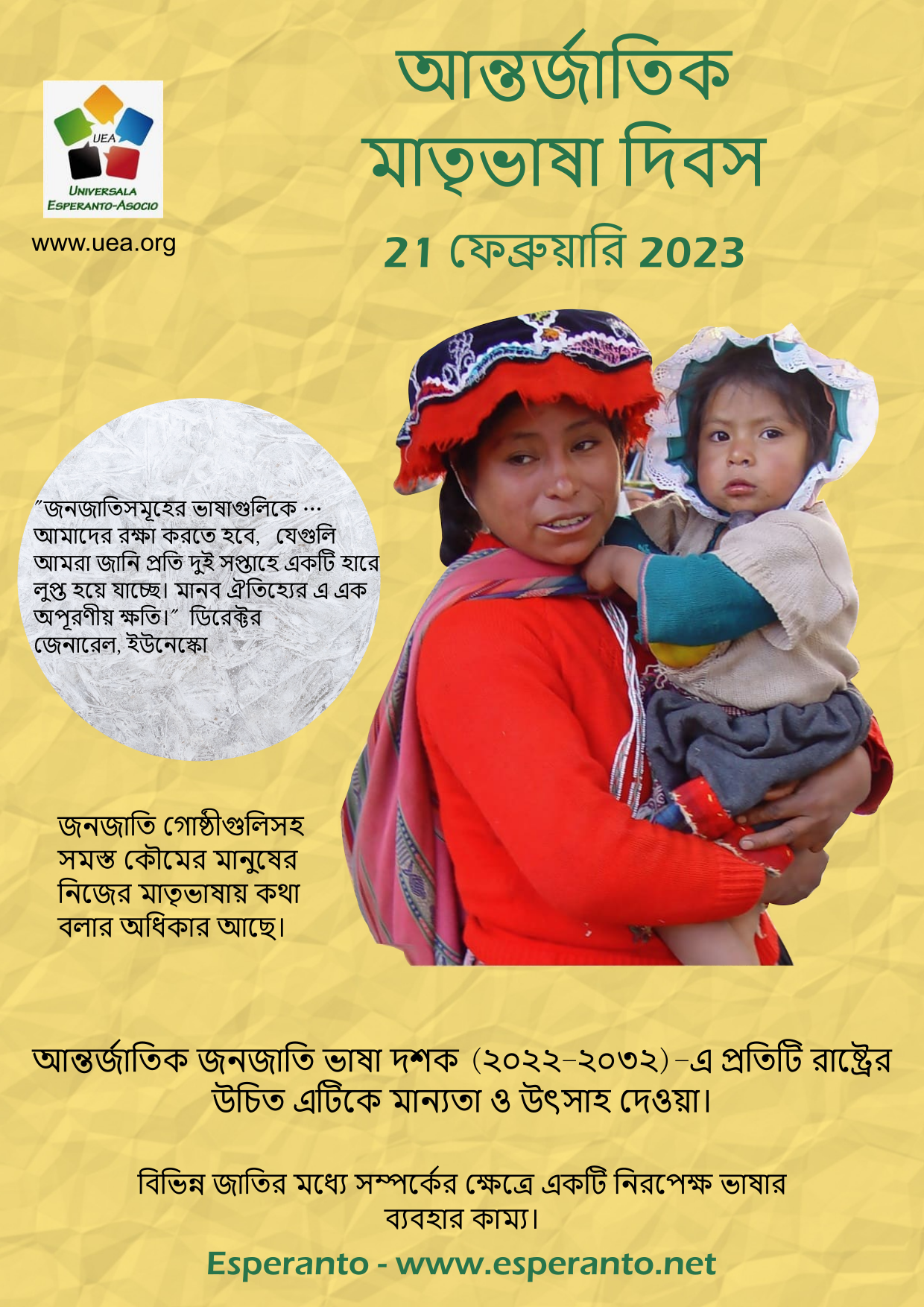
International Mother Language Day Posters

UEA IMLD 2023 poster.
Designed by Stefano Keller.
Tr. A. Giridhar Rao.
February 21st is International Mother Language Day (IMLD). Universala Esperanto Association (UEA) produces a poster every year to mark the event. Stefano Keller in Geneva designed this year's colourful poster. For several years now, Renato Corsetti in London has been getting Esperantists to translate the text of the poster into various languages. Posters from previous years are archived on the multilingual website Linguistic Rights.

This year too, Esperantists (and friends of Esperanto!) in India and Kenya produced texts in several languages. Rafael Lima in New York rapidly incorporated the text into Stefano's poster. Here is a gallery of those posters in Assamese, Bengali, English, Esperanto, Gujarati, Hindi, Kannada, Luo, Malayalam, Marathi, Odia, Punjabi, Sanskrit, Swahili, Tamil, and Telugu!


UEA IMLD 2023 poster in Assamese.
Designed by Stefano Keller.
Tr. Nazrul Haque


UEA IMLD 2023 poster in Bengali.
Designed by Stefano Keller.
Tr. Sajal Dey.

UEA IMLD 2023 poster in Esperanto.
Designed by Stefano Keller.


UEA IMLD 2023 poster in Gujarati.
Designed by Stefano Keller.
Tr. Himanshu Upadhyaya.

UEA IMLD 2023 poster in Hindi.
Designed by Stefano Keller.
Tr. Harjinder Singh Laltu.

UEA IMLD 2023 poster in Kannada.
Designed by Stefano Keller.
Tr. S S Pradhan.

UEA IMLD 2023 poster in Luo.
Designed by Stefano Keller.
Tr. Abado Jack Mtulla, Abado Joseph Mtulla.

UEA IMLD 2023 poster in Malayalam.
Designed by Stefano Keller.
Tr. Anand Kurien.

UEA IMLD 2023 poster in Marathi.
Designed by Stefano Keller.
Tr. Omkar Devlekar.

UEA IMLD 2023 poster in Odia.
Designed by Stefano Keller.
Tr. Amalendu Jyotishi.

UEA IMLD 2023 poster in Punjabi.
Designed by Stefano Keller.
Tr. Harjinder Singh Laltu.

UEA IMLD 2023 poster in Sanskrit.
Designed by Stefano Keller.
Tr. P V Ranganayakulu.

UEA IMLD 2023 poster in Swahili.
Designed by Stefano Keller.
Tr. Abado Jack Mtulla.

UEA IMLD 2023 poster in Tamil.
Designed by Stefano Keller.
Tr. P. Arul Nehru.

UEA IMLD 2023 poster in Telugu.
Designed by Stefano Keller.
Tr. P V Ranganayakulu.


Thursday, August 27, 2020

Multilingual education in India: tasks and challenges

"Multilingual education in India: tasks and challenges" was the (online) talk I gave on 22 August at the London Esperanto Club (in Esperanto). Some 60 Esperantists from around the world logged in. The 30-minute talk followed by an hour's conversation with the audience is available here on YouTube. Do listen to some of it if you want to hear Esperanto spoken more or less as an everyday (second) language! :-) Absorbing as the discussion was, in this post, already too long, I will limit myself to a report on my talk.

The talk began by setting the context of Azim Premji University's social purpose and engagement with school education in India. We then launched into the National Education Policy 2020 (NEP 2020 [PDF]) -- more precisely, to this recommendation:

Wherever possible, the medium of instruction until at least Grade 5, but preferably till Grade 8 and beyond, will be the home language / mother-tongue / local language. Thereafter, the home / local language shall continue to be taught as a language wherever possible. This will be followed by both public and private schools. (Para 4.9, p. 12)

However, before looking at the recommendation more closely, I said that the urgent task at hand during the pandemic was to reopen schools. This has to be done safely. Governments and NGOs like Azim Premji Foundation are putting together guidelines and resources for this. The educational needs of the most vulnerable learners -- Dalits and Adivasis; the nutritional needs of growing children being met through the mid-day meal scheme; the rising incidence of child labour; and especially for girls, early marriages -- these are all aspects of that urgency. The longer the school remains closed, the greater the number of children who will never return to school.

We then came back to the mother-tongue education recommendation in NEP 2020. We noted the difficulty of specifying the mother tongue. Bhojpuri is a case in point. Although it has 51 million native speakers, it is listed (PDF) in the Indian census 2011 as one of the 56 "mother tongues" under Hindi -- as part of the "Hindi belt". Thus, if a Bhojpuri child is being taught in Hindi, it is misleading to claim that the child is being educated in their mother tongue. In operationalizing the policy, the compound "home language / mother-tongue / local language" will need a more nuanced approach.

A second difficulty with the NEP 2020 recommendation is the last sentence in the part cited above: "This will be followed by both public [that is, free] and private [fee-paying] schools." Now, the profit-model of private schools in India crucially depends on English-medium teaching: it is their USP! No wonder, then, that this recommendation has come in for some severe criticism from this vocal and influential lobby. See some of the links in the initial part of this sensible article by Shoaib Daniyal, "Why is India obsessed with English-medium education -- when it goes against scientific consensus?" How policymakers will get this lobby to the table remains to be seen. There may be possibilities in the promise of bilingual education that is mentioned later in the talk.

Fortunately for the private-school lobby, NEP 2020 itself provides several "escape routes"! In the passage cited above, "wherever possible" occurs twice; the 60-page document offers many such "opt-outs, modifications, alternatives, claw-backs" -- as Tove Skutnabb-Kangas has called them. Instead of framing the issue as a matter of linguistic rights, the document presents it as a desirable. Thereby, those reluctant to implement the recommendations will find it easy to not act.

A third battle front for the NEP 2020 recommendation is the fact that in several states the public school system itself is switching to English as medium of instruction! Karnataka has identified a thousand government schools where English-medium education is being given. Neighbouring Telangana is currently training nearly 2000 elementary school teachers to teach in English. These states have adopted English in order to counter the "outflow" of children from regional-language medium government schools to English-medium private schools.

It is too early to say whether the project has worked, but now that government schools themselves are offering English-medium education, parents have started to pull their children out of private schools, and admit them into public schools. The current pandemic, in which millions have lost their livelihoods, has made this option even more attractive. To that extent, one might say that the project is successful.

As I noted in the talk, this third difficulty has shown up a certain incoherence between the NEP 2020 recommendation and the state governments' language policies. This has begun to be noticed elsewhere too as the title of this article indicates: "Will the NEP Throw a Spanner in Jagan Reddy's Plans for English-Medium Education?" What then might be the way forward?

One possible solution seems to be to develop various models of bilingual education. By this, NEP 2020 means English and a regional language. The document mentions bilingual education at several places. For example here:

Students whose medium of instruction is the local / home language will begin to learn science and mathematics bilingually in Grade 6 so that by the end of Grade 9 they can speak about science and other subjects both in their home language and English. In this regard, all efforts will be made in preparing high-quality bilingual textbooks and teaching-learning materials. (Para 4.12, p. 12-13)
If that is indeed the aim, then the extensive English-training programmes that some states are currently undertaking can be seen as preparatory capacity-building for a transition to bilingual education. As the document notes, a great deal of material will need to be developed. In fact, NEP 2020 recommends the setting up of an "Indian Institute of Translation and Interpretation" (IITI) (Para 22.11, p. 53). The availability of such "high-quality" material might prove to be attractive to the private-school system -- including for-profit educational start-ups -- as well.

The bilingual material will need to be both "from-below" (school textbooks and supplementary material for students) as well as "from-above" (teacher training material and university-level material). For decades, governments as well as NGOs have sporadically prepared bilingual material, often for Adivasi children -- that is, bilingual textbooks in the regional language and an Indigenous language. The main reason for these projects not scaling up is lack of sustained state and institutional support: they depended crucially on individual activists and sympathetic officials in the education bureaucracy. The Odisha project (about which I have blogged before) is one of the few with some sustained government support. Perhaps with an IITI that gap will be closed.

Meanwhile, in the sphere of higher education -- the "from-above" as I called it -- the talk gave two examples of intiatives already underway. The first is the "Translations Initiative" (TI) at Azim Premji University. A major objective of TI is to make all the readings of the various programmes of the university available (initially at least) in Hindi and Kannada as well. This will enable access to higher education to a much larger pool of students than only those proficient in English. Simultaneously, TI is organizing "seminars in Indian languages on subjects related to school education in collaboration with different Universities across India".

In alignment with TI is the second initiative that I mentioned in my talk: the National Translation Mission (NTM). I have blogged recently about its work of translating "knowledge texts" into all of India's 22 Official Languages. Hopefully, these initiatives -- those from-below and those from-above -- will together create a sustainable ecosystem for multilingual education in India.

Zooming out, the talk located the 60-page NEP 2020 in the context of a federal democracy: consultation, collaboration, and consent are necessary. And these have to be between multiple stakeholders: central government, state governments, and non-governmental agencies. Further, in the Indian constitution, education is in the Concurrent List -- states too can legislate on the subject. In such a political structure, a readiness to dialogue becomes that much more important.

Finally, the talk acknowledged that the road ahead was long, the challenges would need much work, and the task by its very nature was transgenerational. But without persistence, there would be no way to see the optimism that the Urdu poet Faiz Ahmad Faiz holds out to us:

"It is but a night" by Faiz

The heart is not without hope
It has only not tasted success
Yes, the night of sorrow is long
But it is but a night.

Monday, August 10, 2020

NEP 2020, NTM, and Indian Languages in Higher Education

Language region maps of India. Source: https://commons.wikimedia.org/wiki/File:Language_region_maps_of_India.svg (Filpro / CC BY-SA)


The National Education Policy 2020 (NEP 2020) (PDF) makes several recommendations for education in Indian languages. The 60-page document's recommendations for languages in school education are being discussed quite a lot in the media. In the English media, "Why is India obsessed with English-medium education – when it goes against scientific consensus?", by Shoaib Daniyal, is a sensible look at the current debate, and points to several studies worldwide to make its arguments.

However, this post is about the National Translation Mission (NTM), which is already addressing several of the Policy's recommendations for Higher Education Institutes (HEIs). The Policy observes:

22.7. For languages to remain relevant and vibrant, there must be a steady stream of high-quality learning and print materials in these languages – including textbooks, workbooks, videos, plays, poems, novels, magazines etc. Languages must also have consistent official updates to their vocabularies and dictionaries, widely disseminated so that the most current issues and concepts can be effectively discussed in these languages. Enabling such learning materials, print materials, and translations of important materials from world languages, and constantly updating vocabularies has to become a national priority. (pp. 52-53)

NTM is seriously engaging with a part of this "national priority". Here is a list of the 69 "chief domains" in which NTM has identified "knowledge texts". As their website notes: "All prescribed text books, reference books and articles that are considered foundational in any discipline of college / university education are included for translation. Specific attention is given to the disciplines of Natural Sciences and Social Sciences." The result is a list that currently ranges, alphabetically, from "Adult / Continuing Education" and "Anthropology", through "Linguistics" and "Management", to "Women's Studies" and "Zoology (General)".

To create a network of translators for such a massive project, NTM has been conducting regular Translator Education programmes – currently on hold because of COVID-19.  Here is what their Translator Education page says:

Translator Education Programme of NTM primarily aims to orient the translator towards the translation of knowledge texts. It also offers academic support to those who are willing to take up translation as their profession. It orients translators about the history and tradition of translation in India, problems and challenges in knowledge text translation in Indian Languages and how to use translation tools such as dictionaries, glossaries and thesaurus. It also intends to prepare versatile and efficient professional translators. To achieve the said goal, NTM conducts events like Workshops, Orientation Programmes and Seminars. Translation Today (NTM′s biannual journal), Handbook for Translators, AV materials produced by NTM Media and NTM′s Course Materials would act as apparatus in educating translators.
Thus, NTM is already performing some of the functions envisaged in NEP 2020 for the "proposed Indian Institute of Translation and Interpretation" (p. 53).

Nor is all this somewhere in the future! Here is NTM's 2018-2019 Catalogue of 63 translations already published and available – in India's 22 Official Languages! A few examples of what is already available in their catalogue:

And here's a list of "Shortlisted Books for Translation". There are many more fascinating details: see NTM's Detailed Project Report. Further, appropriately enough for a project addressing India's multilingualism, the NTM website is available not only in English, but in all the other 22 Official Languages as well!

On a smaller scale, such systematic translation projects are going on in other places as well – at Azim Premji University, for example. As details become available, we will blog about those too.

However, as this post shows, there is much to learn from this National Translation Mission project to keep our languages "relevant and vibrant".

Sunday, February 23, 2020

Can a language with millions of speakers be endangered?

"Can a language with millions of speakers be endangered?" asked Maya Ravindranath and Abigail Cohn in 2014. Their sobering answer?

In terms of language endangerment then it seems there is no such thing as "too big to fail".

In this nuanced essay on language endangerment in Indonesia, the authors portray Indonesian as "a successful example of language planning and language standardization in the interest of nation building". But this has diverse implications for other local languages.

However, "the negative impact of Indonesian on local languages is not limited to the “smaller” languages in Indonesia, but is even affecting the larger languages, not generally thought to be at risk." They first demonstrate a weak correlation between number of speakers and language vitality. As they note, "considering how widely it is assumed that language size and vitality correlate this is a startling result."

They then present a case study of Javanese (drawing on the work of others as well). And conclude:

As Indonesian takes over in more and more domains of communication and intergenerational transmission of Javanese breaks down, we are led to conclude that even a language with over 80 million speakers can be at risk, a trend that has serious implications for all of the local languages of Indonesia.

And not only of Indonesia. As Ravindranath and Cohn say, "We hypothesize that this fact may be true elsewhere in the world."

Sunday, June 16, 2019

Esperanto and the translation scene

Photo credit: Yûiti Sawaya‎
The recent launch of the Esperanto volume Vjetnama Antologio (Vietnamese Anthology; details below) is a welcome addition to the diversity of Esperanto literature in translation. Abel Montagut, in a 2004 study, concluded that between 1957 and 1966 in the Esperanto world, English, Russian, French, and German (the "Big Four") accounted for only 30% of the source languages; 70% of the translations into Esperanto were from other languages. In sharp contrast, these Big Four accounted for 70% of the source languages in the UNESCO database Index Translationum

This prompted me to have a quick look at other parts of the world. A June 2019 article by Dan Kopf celebrates that, "in 2018, 632 never-before-translated books of fiction and poetry were published in the United States. It’s the fifth straight year the US has published more than 600 translations". Moreover, as Chad Post notes, "the number of original works of fiction and poetry published annually in the US expanded from roughly 360 in 2008 to more than 600 in recent years. That may not seem like a lot, but a 67% increase over a decade is no fluke."

But Gabriella Page-Fort puts that into perspective: this is 632 out of an estimated 30 000 new books published in the US every year -- that's less that 1%! Indeed, Post mentions the 2005 study which "announced that less than 3% of all the books [not just literary fiction and poetry] published in English [in the United States] were originally written in another language". (And hence his international literature resource, "Three Percent".)

Besides, Kopf tells us, "Of the nearly 5800 books of fiction and poetry translated from 2008 to 2018, more than half were from just nine countries, seven of which are in Europe (the exceptions are Japan and China). Over 10% of books were originally published in France alone. Over that same period, only one book each was translated from Benin, Ethiopia, Kyrgyzstan, Madagascar, Mali, and Myanmar." No Vietnam there, incidentally! (The data comes from the Publishers Weekly database.) The Big Four in the US were French, German, Spanish, and Italian. (In that 2006-photo of my poetry bookshelf, the books are in English, Esperanto, Hindi, and translations from French, Greek, Persian, Sanskrit, and Urdu.)

The situation with German is much better. "German publishers, for example, bought translation rights to 3782 American books in 2002, while American publishers bought rights for only 150 German books," Stephen Kinzer informs us. The situation has only improved since then, notes Page-Fort: "in 2016, 9882 new translations were published in Germany, 13.6% of new releases".

These observers of the translation scene offer a familiar list of reasons for the situation. Here's Post's one-paragraph summary: "economic censorship (translations don’t make profits, so corporations don’t bother with them), they spiral out to a host of intertwined cultural issues: Editors don’t read foreign languages; it doesn’t pay to fund a translator as well as an author; corporate consolidation has made it harder to publish books that sell modestly; indie presses can’t afford to market the foreign titles they do publish; American readers “yawn” at translations, and so bookstores don’t stock them and reviewers (or the handful that have survived the newspaper die-off) don’t review them. The more you look at it, the more the “problem” begins to feel like a self-fulfilling prophecy."

But, as Page-Fort notes: "These dire statistics are focused only on the number of translations published, but demand for international books forces a shift. In China, the top five bestselling fiction books of 2017 were translations (including works by Japan’s Keigo Higashino and Afghan-American author Khaled Hosseini); compare that to the US top five, who were all American, save for Canadian Margaret Atwood. We, the readers, have the power to change this trend."

Post offers another perspective. "If there are a few thousand above-average titles to choose from every year [from the world's languages], why not choose the ones that people will be debating and discussing decades from now, instead of the immediate successes?"

Let me end with Page-Fort again (and with a 2017-photo of five books from my poetry shelf.): "It is easy for me to imagine a more compassionate world, a place where education brings people together and empowers us to find one another through the arts. I would like to think that globalization will lead us toward a new cultural unity; a world where books are as unique as the people who write them and readers are drawn together through stories, beyond the borders of language or country."

I'm glad to see that the world Esperanto movement is playing a role here!

Vjetnama Antologio (2019), edited by Nguyen Thi Phuong Mai and Luon Ngoc Bao, was launched during the 9th Asian-Oceanian Congress of Esperanto in Danang, Vietnam (25-28 April 2019). The book is 14.5 x 20.5 cm, and has 386 pages. Price: 350 VND (about 15 EUR). Cover Photo credit: Yûiti Sawaya‎

Monday, April 15, 2019

Multilingual Education in South Asia - Unicef Report

Early Literacy and Multilingual Education in South Asia” (2019) analyses the varying language situations in South Asia and the existing policies and practices of using languages as medium of instruction (MoI) and as subjects in primary education curriculum. The report's author is Dhir Jhingran of the Language and Learning Foundation. The report concludes that "improving early literacy teaching and learning, and including non-dominant children’s languages in the teaching and learning at primary level, are two of the most important initiatives for ensuring inclusive and equitable student learning" (p. 6).

Here is a chapter-outline of the report (adapted from pp. 5-6):

Chapter 1 presents the rationale for using children’s first language as the medium of instruction. It lays out the principles of language learning, including learning of an unfamiliar language.

Chapter 2 provides a review of learning outcomes of language and literacy in eight countries -- Afghanistan, Bangladesh, Bhutan, India, Maldives, Nepal, Pakistan, and Sri Lanka.

Chapter 3 reviews the language speech patterns and linguistic diversity and complex sociolinguistic situations in each country, including the hierarchy between languages. The issue of the high value attached to learning English and also instruction through the medium of English is discussed.

Chapter 4 presents a typology of school-level sociolinguistic situations commonly found in the region. The approaches of bilingual and multilingual education are introduced. Introduction of non-dominant languages as mediums of instruction requires intense preparation. More importantly, this requires a shift in mindset and attitudes towards these languages and cultures.

Chapter 5 outlines two case studies of mother-tongue-based multilingual education from India and Nepal.

Chapter 6 makes recommendations for policies and programmes for supporting children’s language and literacy learning.

As the report wisely notes: "Prescriptive formulations of policy and programmes will not be effective where language situations are fluid and diverse. The bottom line for any flexible language-in-education policy or programme should be that children’s linguistic and cultural resources must be valued and used" (p. 2).

Hope practitioners, policy makers and educators often return to this report for possibilities and direction!

Citation: Jhingran, D., Early Literacy and Multilingual Education in South Asia, United Nations Children’s Fund Regional Office for South Asia, Kathmandu, 2019.