Showing posts with label multilingualism. Show all posts

Wednesday, November 29, 2023

Multilingualism on Constitution Day

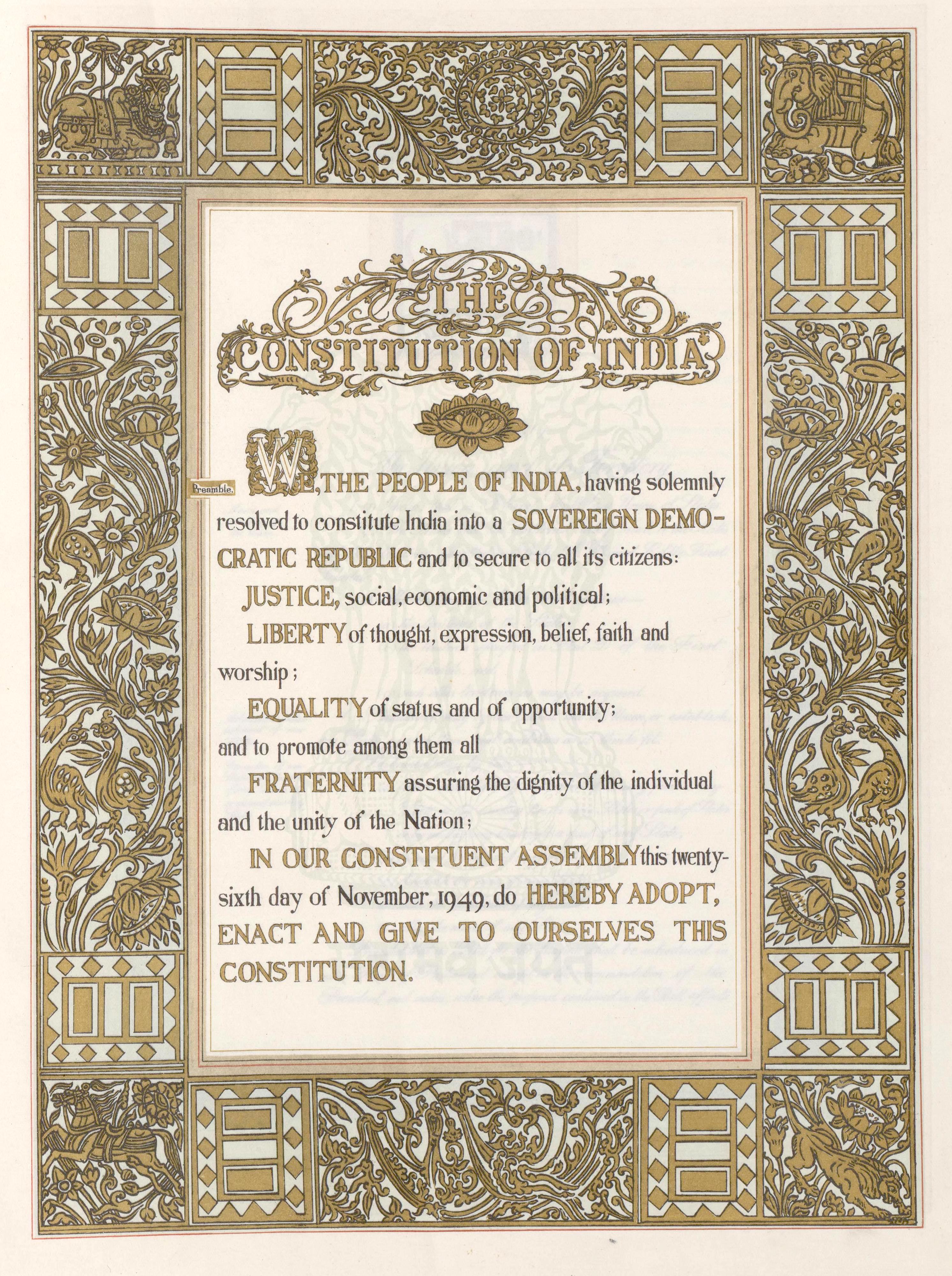
The Preamble
Source: Wikipedia
November 26th is Constitution Day in India, commemorating the day in 1949 when the Constituent Assembly formally adopted the Constitution of India. In 2023, three welcome language-related items caught the eye. The first was a speech made by the Indian President, Droupadi Murmu. The second, the launch of a bilingual edition of the Constitution. The third was the publication of a multilingual e-book of landmark decisions of India's Supreme Court.

First, speaking on the occasion (PDF), President Murmu noted that cost is the most significant barrier in making justice accessible to all. However, she went on to add,

Then, there are other barriers too. For example, language, which is beyond the comprehension of a majority of citizens. I feel reassured by the recent steps taken by the Supreme Court to make the verdicts available in various Indian languages. The live webcast of court proceedings too will go a long way in making citizens true stakeholders of the judicial system.

Second, Constitution Day saw the launch of what news reports called a "diglot" (i. e., bilingual) edition of the Constitution – in English and Manipuri. This edition is in the Meetei Mayek script; the previous edition (2019; PDF) was in the Bengali script. (Oddly, the Constitution has been translated into only a few of the 22 Official Languages of India! Evidently, law students from all other languages rely on these translations or on summaries in their own languages.)

Third, connecting to the President's call, Constitution Day saw the translations of an e-book, Illustrated Cases of the Supreme Court of India, into Bengali, Hindi, Malayalam, Marathi, and Urdu (all PDFs). The book, first published in English in 2018, aims "to democratize access to legal information. It attempts to ensure that the understanding of the landmark decisions are accessible to a broader audience, breaking down language barriers."

The Hindi translation
Source: Manupatra
The language of the English version and its Hindi translation are indeed accessible. For each case, the document presents the facts, questions of law, and the decision. The Hindi translation uses a familiar Hindustani – including Urdu words, rather than only a difficult Sanskrit-derived vocabulary. Further, with relatively unfamiliar Hindi legal terms, the authors have often included the English equivalent in parenthesis. This lays the groundwork for developing a widely available “legal discourse” in our languages. See, for example, the 2012 case related to Right to Education, “Society for Unaided Private Schools of Rajasthan vs. Union of India” (p. 134), and its Hindi version (p. 154).

The infographics in the book are colourful, uncluttered, and informative. All these under-200-page e-books are freely downloadable from Manupatra Academy. One hopes that this book will soon be available (at least!) in all of the country’s official languages.

Laudable initiatives like these are necessary in a multilingual democracy like ours. It should be added that they are useful not only for legal activists and NGOs. Such material is very useful in India’s education system too, where there are deep inequalities: some groups and regions get a good education; many do not. In secondary schools and colleges such high quality, accessible summaries can supplement translations of the original documents. The educational use of such material will facilitate critical engagement with complex arguments. But that is a theme for another post!

Meanwhile, the publication of such accessible summaries in multiple languages is a welcome development. As President Murmu noted, “The cause of justice is best served by making it accessible for all. This also strengthens equality.”

(This post also appears in the section "Faculty Perspectives" on the Azim Premji University website.)

Monday, August 10, 2020

NEP 2020, NTM, and Indian Languages in Higher Education

Language region maps of India. Source: https://commons.wikimedia.org/wiki/File:Language_region_maps_of_India.svg (Filpro / CC BY-SA)


The National Education Policy 2020 (NEP 2020) (PDF) makes several recommendations for education in Indian languages. The 60-page document's recommendations for languages in school education are being discussed quite a lot in the media. In the English media, "Why is India obsessed with English-medium education – when it goes against scientific consensus?", by Shoaib Daniyal, is a sensible look at the current debate, and points to several studies worldwide to make its arguments.

However, this post is about the National Translation Mission (NTM), which is already addressing several of the Policy's recommendations for Higher Education Institutes (HEIs). The Policy observes:

22.7. For languages to remain relevant and vibrant, there must be a steady stream of high-quality learning and print materials in these languages – including textbooks, workbooks, videos, plays, poems, novels, magazines etc. Languages must also have consistent official updates to their vocabularies and dictionaries, widely disseminated so that the most current issues and concepts can be effectively discussed in these languages. Enabling such learning materials, print materials, and translations of important materials from world languages, and constantly updating vocabularies has to become a national priority. (pp. 52-53)

NTM is seriously engaging with a part of this "national priority". Here is a list of the 69 "chief domains" in which NTM has identified "knowledge texts". As their website notes: "All prescribed text books, reference books and articles that are considered foundational in any discipline of college / university education are included for translation. Specific attention is given to the disciplines of Natural Sciences and Social Sciences." The result is a list that currently ranges, alphabetically, from "Adult / Continuing Education" and "Anthropology", through "Linguistics" and "Management", to "Women's Studies" and "Zoology (General)".

To create a network of translators for such a massive project, NTM has been conducting regular Translator Education programmes – currently on hold because of COVID-19.  Here is what their Translator Education page says:

Translator Education Programme of NTM primarily aims to orient the translator towards the translation of knowledge texts. It also offers academic support to those who are willing to take up translation as their profession. It orients translators about the history and tradition of translation in India, problems and challenges in knowledge text translation in Indian Languages and how to use translation tools such as dictionaries, glossaries and thesaurus. It also intends to prepare versatile and efficient professional translators. To achieve the said goal, NTM conducts events like Workshops, Orientation Programmes and Seminars. Translation Today (NTM′s biannual journal), Handbook for Translators, AV materials produced by NTM Media and NTM′s Course Materials would act as apparatus in educating translators.
Thus, NTM is already performing some of the functions envisaged in NEP 2020 for the "proposed Indian Institute of Translation and Interpretation" (p. 53).

Nor is all this somewhere in the future! Here is NTM's 2018-2019 Catalogue of 63 translations already published and available – in India's 22 Official Languages! A few examples of what is already available in their catalogue:

And here's a list of "Shortlisted Books for Translation". There are many more fascinating details: see NTM's Detailed Project Report. Further, appropriately enough for a project addressing India's multilingualism, the NTM website is available not only in English, but in all the other 22 Official Languages as well!

On a smaller scale, such systematic translation projects are going on in other places as well – at Azim Premji University, for example. As details become available, we will blog about those too.

However, as this post shows, there is much to learn from this National Translation Mission project to keep our languages "relevant and vibrant".

Sunday, July 22, 2018

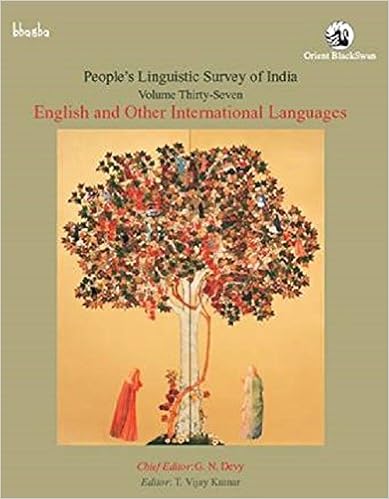
PLSI volume on English and other international languages

Volume 37 (of the projected 50 volumes) of the People's Linguistic Survey of India (PLSI) is being launched in Hyderabad on 27 July 2018. This volume is titled English and Other International Languages.

As the publisher's blurb says, the book "discusses the status of English and other foreign languages which continue to have a presence in India. While Section I discusses the complex progression of English in the Indian linguistic scene and its increasing acceptance among the people here, Section II describes the status and development of eight other international languages in use in India. The volume also observes how India’s engagement with foreign cultures has enriched the multilingual mosaic of the country."

The other eight languages are: Chinese, French, German, Japanese, Korean, Portuguese, Russian, and Spanish in India. This post deals only with the section on English. The 20 chapters include my essay, "English as the Medium of Instruction at School" (PDF). The contents of the volume are listed here.

The 27 July launch will feature both the series editor Ganesh Devy, as well as the volume editor T. Vijay Kumar.

The volume also has a useful set of appendices. Here is the list with links to where they can be found on the net:

I. Mother English (1854) -- a poem by Savitribai Phule

II. Address, dated 11th December 1823, from Raja Rammohan Roy to Lord Amherst

III. Minute on Indian education by the Hon’ble T. B. Macaulay, dated 2nd February 1835

IV. Gandhi on the English Language - 5 excerpts from his writings. Two books that bring together Gandhi's writings on education are Towards New Education (ed. Bharatan Kumarappa, 1953) and Evil Wrought by the English Medium (ed. K. R. Prabhu, 1958)

V. Debates in the Constituent Assembly on the English language, Constituent Assembly of India Volume III, Friday 2nd May, 1947 -- A recent commentary on the debates is by Rama Kant Agnihotri, "Constituent Assembly Debates on Language", Economic and Political Weekly, Vol. 50, Issue No. 8, 21 Feb, 2015

VI. Address by Prime Minister Dr Manmohan Singh at Oxford University -- the comments on English language are in this transcript.

VII. Excerpts from interviews with Chandrabhan Prasad -- The Wikipedia entry on him gives the links to many of his writings.

All in all, the PLSI volume promises to be a rich resource.

Tuesday, June 19, 2018

Multilingual education in India report coming in July 2018

The "early research findings" of the language and literacy project MultiLila will be announced and discussed in a two-day seminar in New Delhi in July 2018. The project's formal title is Multilingualism and Multiliteracy: Raising learning outcomes in challenging contexts in primary schools across India. This four-year UK-India project with its extensive, multidisciplinary network of partners (including institutions and people we have met often in this blog) began in 2016. Its primary question is "Why do some children in India not benefit from being multilingual or bilingual to the same degree as children in other ESL/EFL contexts?" (ESL is English as a Second Language, and EFL is English as a Foreign Language.)

As Mukhopadhyay (see below) notes, the project covers:
  • 1200 children in 4th standard [i. e. 10-year-olds] to be tested at two time points (4th and 5th standard)
  • 800 children living in urban areas in Delhi and Hyderabad (200 in slums, 200 in non-slums)
  • 400 children living in rural areas in Bihar-Patna (200 in semi-urban, 200 in urban areas)
  • Average ability children, no history of learning disabilities
  • No children from upper end of middle class or above
Some of the other questions the project asks are:
  • Is there a relationship between basic literacy and numeracy levels and school drop-out rates on the one hand, and language of instruction and support for MT education provision on the other?
  • Is multiliteracy associated with better skills in critical thinking and problem solving when MT literacy is available?
  • Are critical thinking and problem solving skills in the medium of instruction transferred in the child’s use of English for similar tasks?
  • Do multilingual children show comparable developmental knowledge of semantic fluency, syntactic knowledge, reading and retelling skills across MT and English?
One of the project's co-investigators, Lina Mukhopadhyay, amplified some of the objectives in the Language and Development Conference in 2017 (PDF):
  • To explore how the complex dynamics of social, economic and geographical contexts affect the delivery of quality of multilingual education in India.
  • To investigate how educational policy regarding the role of mother-tongue education (the three language formula) is implemented in schools, and how the language(s) of instruction impact on learning outcomes in basic literacy and numeracy but also higher level literacy skills expressed through critical thinking and problem solving in the language of education and in the development of English as a second language.
  • To evaluate how negative consequences of [structural inequality]... on learning outcomes can be attenuated when mother-tongue education is available.
We look forward to learning more about the seminar and the project's report, Multilingual classrooms: opportunities and challenges for English medium instruction in low and middle-income countries.

Wednesday, November 8, 2017

Language and Education resources at Early Literacy Initiative

In September 2017 I argued for MTME -- Mother-Tongue Based Multilingual Education -- in a blog post titled "Why Mother Tongue Medium in a Multilingual Context?"

The post is part of the recently launched website, Early Literacy Initiative (ELI), of the Tata Institute of Social Sciences (TISS). As the ELI website states:

ELI is working broadly towards accomplishing:

  1. Research: To conduct new research in early language and literacy in India; and to disseminate knowledge that is already available.
  2. Teaching: To create a cadre of knowledgeable and well-prepared professionals in the area of early language and literacy.
  3. Advocacy: To provide visibility and leadership to work in early language and literacy by engaging in national level dialogues with scholars, policy-makers and other professionals working in allied areas. ELI will also provide networking support for practitioners and scholars working in the domain through a variety of means, such as, a visible and dynamic web presence, offering short-term workshops and courses, collecting and disseminating relevant information, and so on.

The blog is organized thematically. Their first theme is multilingualism. The website's Resources are organized around general interest, themes, handouts and publications, and talks and presentations.

All in all, ELI promises some interesting conversations!

Sunday, May 14, 2017

Some myths about language

Osmania University celebrates its centenary this year (plus a few other anniversaries!). As part of its celebrations, it has brought out a freely downloadable volume called Insights on Global Challenges and Opportunities for the Century Ahead -- here's the link to the 27-MB PDF.

As the Preface notes, the 400-page volume "contains 81 articles with insights from eminent personalities including Nobel laureates, World Food Prize winners, Padma awardees, Heads of national and international organizations, distinguished scientists, social workers, and spiritual leaders."

Among the several interesting contributions to the volume is "Some myths about language" by Duggirala Vasanta, Aditi Mukherjee, and Dipti Mishra-Sharma (pp. 95-99). Addressing a general audience, they briefly discuss the following 10 myths:

Myth 1: Sanskrit is the ‘mother’ of all Indian languages.

Myth 2: Borrowing from other languages or language-mixing ‘spoils’ the purity of a language.

Myth 3: ‘Dialects’ are inferior to ‘languages’.

Myth 4: ‘Script’ is an essential part of language.

Myth 5: Exposing preschool children to multiple languages / scripts will hinder their cognitive growth.

Myth 6: The alphabetic writing system of English is inherently superior compared to Indian scripts.

Myth 7: Sign languages are not real languages / there is just one universal sign language.

Myth 8: Men and women differ in their linguistic / spatial abilities because their brains are wired differently.

Myth 9: Machine Translation (MT) will replace human translators.

Myth 10: Machine Translation output quality is so bad that it is useless.

Do take a look at these useful reminders.

Thursday, June 23, 2016

Stellenbosch University - New Language Policy

Stellenbosch University (SU) has a new Language Policy (PDF, 12 pages). The university went through an elaborate consulation exercise. The policy in "essence"
advances institutional multilingualism and individual multilingualism in [the university's] academic, administrative, professional and social contexts. The Policy aims to increase equitable access to SU for all students and staff. Since our campuses are situated in the Western Cape, we commit ourselves to the promotion of the province’s three official languages, namely Afrikaans, English and isiXhosa.
The policy comes in the wake of what a news report describes as "chaotic scenes last year as student lobby group Open Stellenbosch protested against the language policy‚ arguing that the policy "safeguards Afrikaner culture" and excludes black students. The group demanded that English be the main language of instruction."

The new policy, though, gives equal status to the two languages: "Afrikaans and English are SU’s languages of learning and teaching" (p. 4). Section 7.5 of the policy, "Promotion of multilingualism" spells out some of the provisions for Afrikaans and isiXhosa.
7.5.3 SU advances the academic potential of Afrikaans by means of, for example, teaching, conducting research, holding symposia, presenting short courses, supporting language teachers and hosting guest lecturers in Afrikaans; presenting Afrikaans language acquisition courses; developing academic and professional literacy in Afrikaans; supporting Afrikaans reading and writing development; providing language services that include translation into Afrikaans, and editing of and document design for Afrikaans texts; developing multilingual glossaries with Afrikaans as one of the languages; and promoting Afrikaans through popular-science publications in the general media.
7.5.4 IsiXhosa as an emerging formal academic language receives particular attention for the purpose of its incremental introduction into selected disciplinary domains, prioritised in accordance with student needs in a well-planned, well-organised and systematic manner.... In certain programmes, isiXhosa is already used with a view to facilitating effective learning and teaching, especially where the use of isiXhosa may be important for career purposes. SU is commited to increasing the use of isiXhosa, to the extent that this is reasonably practicable, for example through basic communication skills short courses for staff and students, career-specific communication, discipline-specific terminology guides (printed and mobile applications) and phrase books.
Here are some other learning and teaching provisions of the new policy.

7.1.3.2 Learning opportunities, such as group work, assignments, tutorials and practicals involving students from both language groups are utilised to promote integration within programmes.

7.1.4 For undergraduate modules where both Afrikaans and English are used in the same class group...:
7.1.4.1 During each lecture, all information is conveyed at least in English and summaries or emphasis on content are also given in Afrikaans. Questions in Afrikaans and English are, at the least, answered in the language of the question.
7.1.4.3 For first-year modules, SU makes simultaneous interpreting available during each lecture. During the second and subsequent years of study, simultaneous interpreting is made available by SU upon request by a faculty, if the needs of the students warrant the service and SU has the resources to provide it. If two weeks have passed with no students making use of the interpreting service, it may be discontinued.
7.1.5.3 Where all the students in the class group agree to it by means of a secret ballot, the module will be presented in Afrikaans only or English only, provided that the relevant lecturers and teaching assistants have the necessary language proficiency and agree to do so.

7.1.7.1 All compulsory reading material is provided in English except where the module is about the language itself.

7.1.7.2 Compulsory reading material (excluding published material) is also provided in Afrikaans unless it is not reasonably practicable to do so.

7.1.8 Question papers for tests, examinations and other summative assessments are available in Afrikaans and English. Students may answer all assessments and submit all written work in Afrikaans or English.

7.1.9 In postgraduate learning and teaching any language may be used provided all the relevant students are sufficiently proficient in that language.

7.1.10.1 Where students or staff need alternative texts such as Braille or enlarged texts as a means to communicate and understand information and these are not available, the relevant member of staff should liaise with SU’s Braille Office to arrange the timeous availability of the alternative texts.

7.1.10.2 As South African Sign Language is the primary means of communication for some Deaf people, a sign language interpreter and/or real-time captioning is available during lectures, tutorials and principal SU public events, where it is required and it is reasonably practicable to do so.

The policy lapses after 5 years from its date of implementation. Within this period, or latest during its fifth year, it must be reviewed.

Sunday, July 14, 2013

Nitobe Symposium on Languages and Internationalization in Higher Education

The 6th Nitobe Symposium is on "Languages and Internationalization in Higher Education: Ideologies, Practices, Alternatives", July 18-20, 2013, at the National Museum of Iceland, Reykjavik, Iceland.

From the Symposium website: "The symposium will be particularly concerned with the expanding use of English-medium instruction in higher education and the repercussions, positive and negative, of this development. The symposium will also examine alternative approaches."

Organized by the Centre for Research and Documentation on World Language Problems (CRD),  the Symposium's multilingual Background Papers themselves are useful reading. And here is the list of Paper Summaries.

Saturday, September 18, 2010

MT as bridge language of instruction in SE Asia - report

Just received a link to this 2009 publication, Mother tongue as bridge language of instruction: policies and experiences in Southeast Asia. Will blog more on it later, but for now here's what the blurb says:

This publication, 'Mother tongue as bridge language of instruction: policies and experiences in Southeast Asia,' presents a compendium of language policies, case studies, and general recommendations for mother tongue-based education in Southeast Asian Ministers of Education Organization (SEAMEO) member countries. It provides insights that may further strengthen each country's policies concerning language of instruction as a way to achieve education for all. This book is a result of a consultative workshop organized by the SEAMEO Secretariat and the World Bank for SEAMEO member countries in February 2008.

The workshop aimed to increase understanding of the issues and strategies related to basic education for ethnolinguistic minority communities in Southeast Asia. Above all, this book takes the position that the learners' mother tongue is a bridge to further education, and that multilingualism is a tool for building bridges between people.

Here's the table of contents:

Contents

Foreword
Dato' Dr Ahamad bin Sipon, Director, SEAMEO Secretariat

Chapter 1 Introduction 8
Kimmo Kosonen and Catherine Young

Chapter 2 Language-in-education policies in 22
Southeast Asia: an overview
Kimmo Kosonen

Chapter 3 Various policies in Southeast Asian 44
countries

Introduction 44

The evolution of language-in-education policies 49
in Brunei Darussalam
Gary Jones

Education policies for ethnic minorities in 62
Cambodia
Neou Sun

Regional and local languages as oral languages 69
of instruction in Indonesia
Maryanto

Policies, developments, and challenges in mother 76
tongue education in Malaysian public schools
Ramanathan Nagarathinam

Language-in-education policies and their 84
implementation in Philippine public schools
Yolanda S Quijano and Ofelia H Eustaquio

Language and language-in-education policies 93
and their implementation in Singapore
Elizabeth S Pang

Language policy and practice in public 102
schools in Thailand
Busaba Prapasapong

Language-in-education policies in Vietnam 109
Bui Thi Ngoc Diep and Bui Van Thanh

Chapter 4 Good practices in mother tongue-first 120
multilingual education
Catherine Young

Chapter 5 Case studies from different countries 136

Introduction 136

Mandarin as mother tongue in Brunei 139
Darussalam: a case study
Debbie GE Ho

The mother tongue as a bridge language of 148
instruction in Cambodia
Un Siren

A case study on the use of Kadazandusun in 153
Malaysia
Sandra Logijin

The mother tongue as a bridge language of 159
instruction in two schools in La Paz, Agusan del
Sur, the Philippines: a case study
Yolanda S Quijano and Ofelia Eustaquio

Bilingual literacy for the Pwo-Karen community in 171
Omkoi District, Chiangmai Province: a case study
from Thailand
Wisanee Siltragool, Suchin Petcharugsa & Anong Chouenon

A mother tongue-based preschool programme 180
for ethnic minority children in Gia Lai, Vietnam
Hoang Thi Thu Huong


Chapter 6 The way forward in Southeast Asia: 190
general recommendations
Kimmo Kosonen & Catherine Young

References 196

Contributors 207

Monday, July 5, 2010

Linguistic human rights in India: policy and practice

Last month EFLU's new journal Languaging published my article "Linguistic human rights in India: policy and practice".

The issue is not (yet?) available online. But the link above will take you to the PDF version of the manuscript that I submitted to the journal.

Comments, as ever, welcome!

Tuesday, August 11, 2009

National security in education

In an op-ed in The Hindu, "Questions of real national security", scientist and well-known public intellectual Pushpa Bhargava dicusses "agriculture security... education security, and health security". But in his five paragraphs on education, mother-tongue medium education finds no mention at all. This is a pity. Coincidentally, another part of the same newspaper reviews Multilingual Education for Social Justice: Globalising the Local - "a passionate call to respect and enshrine the inalienable right of all the children of the world to learn their languages and through their languages."

Bhargava rightly bemoans the quality of India's government-school education (which is overwhelmingly in the dominant regional language). What he does not say is that children of indigenous peoples and linguistic-minorities suffer doubly under such a system: a bad education made worse by a non-mother-tongue medium! This no doubt contributes to the official elementary-school drop-out rate of nearly 49%.

But Bhargava also disapproves of the extensive commercialization of both school and higher (including professional) education: "education has become a commodity to be sold and purchased." In the current ASER report on school education, Amit Kaushik in his essay "The Shift to Private Schools" alerts us that enrolments in private schools have increased from 16.4% in 2005, to 22.5% in 2008, even as "learning levels appear to be stagnating or declining":

"only 41 percent across Grades 1 to 8 [were] able to read simple stories in 2008 as opposed to 43.6 percent in 2005. Similarly, only 27.9 percent children across grades could do simple division sums in 2008, as compared to 30.9 percent in 2005. This decline is observed in both government and private schools, even though the latter continue to maintain a marginally higher level than the government schools, at least on an all India basis. However, as has been shown elsewhere in this Report, in many States there is little or no difference in the performance of government and private schools, and in many the performance of the latter is far lower than that of government schools in some of the other, more educationally advanced States. In an uncomfortably large number of cases then, receiving a private school education would clearly seem to be no guarantor of acquiring any significantly better learning."

Clearly, an English-medium education (among the attractions of a private-school education) is not helping these children learn at all! These schools are yet more instances of the "early-start and maximal-exposure" myths that I blogged about recently.

Back to Bhargava: "It is no surprise, therefore, that 80 per cent of the engineering graduates (in fact, graduates in all areas) India produces are unemployable." These are figures amplified by others, for example in this article in Outlook:

"In the intensely desired world of BPOs, IT majors and MNCs, language gatekeepers are turning down all but a minuscule number of applying graduates. According to Uma K. Raman, head, Skills Enhancement, HCL BPO, her company rejects 92-93 per cent of applicants for poor English. Sandhya Chitale, director, Nasscom's Educational Initiative, puts the rejection rate for non-engineering graduates applying to the IT and IT-enabled sector, both in "voice" and "non-voice" roles, at 82-83 per cent, for lack of soft skills, including written and oral English. About 65-75 per cent of applying engineers are rejected for the same reasons."

Anjali Puri, the author of that despairing essay "English Speaking Curse", says:

"The teachers make an important fundamental point, which I hear repeated, time and again, by teachers in other institutions. These problems have their roots in students being language-impoverished rather than just English-impoverished (that is, demonstrating a poor ability in regional languages too), and being virtually cut off from the humanities stream from senior school."

In other words, the education of these students is typical case of a subtractive multilingualism: the dominant, "prestige" language is rarely learnt well, and even when it is, this happens at the expense of the home language(s).

This is why Pushpa Bhargava should have emphasized the language question while speaking of an education system that promotes national security. He rightly identifies the need in India for "a knowledge society in which every citizen has a minimum amount of knowledge." The way to that is through mother-tongue medium based multilingual education.

The crucial message of Multilingual Education for Social Justice: Globalising the Local (click here for ordering information) needs to spread.

Saturday, September 27, 2008

European Day of Languages in Hyderabad

Here's the final version (15 Oct) of a press release that I recently put together (there's also an Esperanto version).

On the occasion of

European Day of Languages

European Language Mela

20 October 2008
The English and Foreign Languages University
Hyderabad

Institutes in Hyderabad which teach European languages will come together on 20 October to celebrate the European Day of Languages. The English and Foreign Languages University (EFLU) will host a "European Language Mela".

"The event is the first of its kind in India, and will showcase the rich diversity of languages in Europe," said Professor Abhai Maurya, Vice-Chancellor, EFLU. He added, "The event takes on added significance in 2008, which the United Nations has declared International Year of Languages."

Participating institutes include Alliance Française, Goethe Zentrum, Osmania University, Universal Esperanto Association, and University of Hyderabad. As many as eight European languages will be presented – Croatian, English, Esperanto, French, German, Italian, Russian, and Spanish – followed by a discussion.

Over the next few months, several Language Days are being planned by these institutes to present these languages and their cultures in greater depth.

Backgrounder

Launched in 2001, the European Day of Languages, which is traditionally celebrated on or around 26 September, promotes linguistic diversity as a tool for greater intercultural understanding. There are over 200 languages indigenous to Europe and many more are spoken by citizens whose family origin is from other continents.

Some factoids:

  • The mother tongues spoken by most people in Europe are Russian, German, English, French and Italian, in that order.


  • The non-European languages most widely used on European territory are Arabic, Chinese and Hindi, each with its own writing system.


  • Russia (148 million inhabitants) has by far the highest number of languages spoken on its territory: from 130 to 200 depending on the criteria.


  • Most countries in Europe have a number of regional or minority languages – some of these have obtained official status.


  • Due to the influx of migrants and refugees, Europe has become largely multilingual. In London alone some 300 languages are spoken (Arabic, Turkish, Kurdish, Berber, Hindi, Punjabi, etc.).


Bilingualism. Let us recognize, use and cherish this resource. Bilingualism brings all kinds of benefits. Being bilingual can enhance your chances of successfully learning other languages. Learning a second language makes it easier to learn a third. Bilinguals may also have some advantages in thinking: there is evidence that they make faster progress than monolinguals in certain areas of early cognitive development and are in many ways more creative in their linguistic skills.

Bilinguals can communicate with a wider variety of people. Since bilinguals can experience two or more cultures in an intimate way, their ability can make them more sensitive in communication and more ready to overcome cultural barriers and to build cultural bridges. There are also important practical issues: bilinguals enjoy a potential economic advantage because a larger number of jobs becomes available to them. It is also increasingly accepted that multilingual companies have a competitive edge over monolingual ones.

Minority languages. Thus, in a globalizing world high-level multilingualism is very desirable. The conditions to achieve high-level multilingualism are quite favourable for the big languages. A 10-year schooling in the mother-tongue lays a solid cognitive foundation on which other languages can be effectively acquired. However, as in the rest of the world, in Europe too the situation of the smaller languages is far more uncertain – indeed, for the world as a whole, experts estimate that over this century, at least half of the world’s languages, and perhaps more, will die out. Within two generations all traces of a language can disappear when it is not spoken at home, and when children are not taught in it at school. It is this urgency that has prompted the United Nations to declare 2008 “International Year of Languages”.

As a community of nations committed to defending human rights – including linguistic human rights – Europe is seriously discussing strategies to ensure these rights for all its citizens. A range of proposals exist: initiatives to encourage citizens to learn the languages of the neighbours; a 'simplified' English; adopting a national language as one's own; declaring a national language as the official European language; and learning a planned language like Esperanto as a universal second language.

Europe's success in defending linguistic human rights, promoting linguistic diversity and democracy, and achieving a high-level multilingualism will be watched with great interest in other multilingual mosaics such as India.

As we – with our own complex mix of languages! – gather to celebrate Europe's linguistic diversity, these are some of the larger issues that we invite you to ponder over during the seminar. Indeed, we hope that our celebrations and deliberations will continue through the various European Language Days that we plan to organize during the next few months in Hyderabad!

Some useful websites