Showing posts with label english. Show all posts

Sunday, July 22, 2018

PLSI volume on English and other international languages

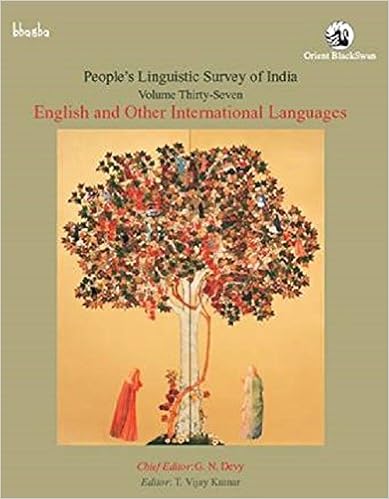
Volume 37 (of the projected 50 volumes) of the People's Linguistic Survey of India (PLSI) is being launched in Hyderabad on 27 July 2018. This volume is titled English and Other International Languages.

As the publisher's blurb says, the book "discusses the status of English and other foreign languages which continue to have a presence in India. While Section I discusses the complex progression of English in the Indian linguistic scene and its increasing acceptance among the people here, Section II describes the status and development of eight other international languages in use in India. The volume also observes how India’s engagement with foreign cultures has enriched the multilingual mosaic of the country."

The other eight languages are: Chinese, French, German, Japanese, Korean, Portuguese, Russian, and Spanish in India. This post deals only with the section on English. The 20 chapters include my essay, "English as the Medium of Instruction at School" (PDF). The contents of the volume are listed here.

The 27 July launch will feature both the series editor Ganesh Devy, as well as the volume editor T. Vijay Kumar.

The volume also has a useful set of appendices. Here is the list with links to where they can be found on the net:

I. Mother English (1854) -- a poem by Savitribai Phule

II. Address, dated 11th December 1823, from Raja Rammohan Roy to Lord Amherst

III. Minute on Indian education by the Hon’ble T. B. Macaulay, dated 2nd February 1835

IV. Gandhi on the English Language - 5 excerpts from his writings. Two books that bring together Gandhi's writings on education are Towards New Education (ed. Bharatan Kumarappa, 1953) and Evil Wrought by the English Medium (ed. K. R. Prabhu, 1958)

V. Debates in the Constituent Assembly on the English language, Constituent Assembly of India Volume III, Friday 2nd May, 1947 -- A recent commentary on the debates is by Rama Kant Agnihotri, "Constituent Assembly Debates on Language", Economic and Political Weekly, Vol. 50, Issue No. 8, 21 Feb, 2015

VI. Address by Prime Minister Dr Manmohan Singh at Oxford University -- the comments on English language are in this transcript.

VII. Excerpts from interviews with Chandrabhan Prasad -- The Wikipedia entry on him gives the links to many of his writings.

All in all, the PLSI volume promises to be a rich resource.

Tuesday, June 19, 2018

Multilingual education in India report coming in July 2018

The "early research findings" of the language and literacy project MultiLila will be announced and discussed in a two-day seminar in New Delhi in July 2018. The project's formal title is Multilingualism and Multiliteracy: Raising learning outcomes in challenging contexts in primary schools across India. This four-year UK-India project with its extensive, multidisciplinary network of partners (including institutions and people we have met often in this blog) began in 2016. Its primary question is "Why do some children in India not benefit from being multilingual or bilingual to the same degree as children in other ESL/EFL contexts?" (ESL is English as a Second Language, and EFL is English as a Foreign Language.)

As Mukhopadhyay (see below) notes, the project covers:
  • 1200 children in 4th standard [i. e. 10-year-olds] to be tested at two time points (4th and 5th standard)
  • 800 children living in urban areas in Delhi and Hyderabad (200 in slums, 200 in non-slums)
  • 400 children living in rural areas in Bihar-Patna (200 in semi-urban, 200 in urban areas)
  • Average ability children, no history of learning disabilities
  • No children from upper end of middle class or above
Some of the other questions the project asks are:
  • Is there a relationship between basic literacy and numeracy levels and school drop-out rates on the one hand, and language of instruction and support for MT education provision on the other?
  • Is multiliteracy associated with better skills in critical thinking and problem solving when MT literacy is available?
  • Are critical thinking and problem solving skills in the medium of instruction transferred in the child’s use of English for similar tasks?
  • Do multilingual children show comparable developmental knowledge of semantic fluency, syntactic knowledge, reading and retelling skills across MT and English?
One of the project's co-investigators, Lina Mukhopadhyay, amplified some of the objectives in the Language and Development Conference in 2017 (PDF):
  • To explore how the complex dynamics of social, economic and geographical contexts affect the delivery of quality of multilingual education in India.
  • To investigate how educational policy regarding the role of mother-tongue education (the three language formula) is implemented in schools, and how the language(s) of instruction impact on learning outcomes in basic literacy and numeracy but also higher level literacy skills expressed through critical thinking and problem solving in the language of education and in the development of English as a second language.
  • To evaluate how negative consequences of [structural inequality]... on learning outcomes can be attenuated when mother-tongue education is available.
We look forward to learning more about the seminar and the project's report, Multilingual classrooms: opportunities and challenges for English medium instruction in low and middle-income countries.

Thursday, January 5, 2017

MTME needed beyond early grades

In his fortnightly column, Anurag Behar has just published 'The focus for education in 2017' - a comprehensive 'cheat-sheet' of 'approaches and issues, which will be worked upon and fought about, this year and next'. The list of 25 issues range from the high-minded (constitutional values) to the everyday (inadequate water in schools).

About mother-tongue education, he says:
21. Mother tongue is the most effective medium of education in early grades. However, given the reality of the social capital of English, all children must have the opportunity to learn the language.
In fact, mother-tongue medium (MTM) education is most effective not just in early grades. It is most effective throughout the schooling years. Several studies show that length of time spent in mother-tongue (L1) schooling is the best predictor of academic performance. This includes performance in the second language (L2). In the world's largest longitudinal study of minority education (over 210 000 students), Thomas and Collier (2002: 7) conclude that 'the strongest predictor of L2 student achievement is the amount of formal L1 schooling. The more L1 grade-level schooling, the higher L2 achievement'. Early-exit to a dominant language does not yield good outcomes. What is needed is a mother-tongue based multilingual education (MTME).

Regarding this study and another, Skutnabb-Kangas and Dunbar (2010: 96) note, 'The length of MTM education was... more important than any other factor (and many were included) in predicting the educational success of bilingual students. It was also much more important than socio-economic status.' We've blogged earlier about their excellent overview of education of indigenous peoples, tribals and minorities. In the context of this post, see especially Chapter 8, 'What forms of education would be consistent with law and research?' (and section 8.1.3 therein).

Earlier in their monograph, Skutnabb-Kangas and Dunbar also cite Kathleen Heugh's study (2000) in South Africa (which we've blogged about too) which shows that even under the racist policies of apartheid,
secondary school pass rate rose, with 8 years of MTM, to 83.7% by 1976 and the English language as a subject pass rate rose to over 78%. When after the Soweto uprising MTM education went down to only 4 years, with an earlier transition to English-medium, the secondary school pass rate declined to 44% by 1992, with a parallel decline in English language proficiency. (p. 53)
A final pair of examples for this post are from Assam and Odisha in India, from the work by Ajit Mohanty and his colleagues. In a well-controlled study, Bodo children learning in Bodo-medium outperformed Bodos studying in the regional language Assamese. In Odisha, Kui-speaking tribal Kond children in Kui-Odia bilingual programmes 'in their later grades (i.e. the high school grades) were found to perform in Odia language tasks at the same level as the Odia-only monolingual children'. (Skutnabb-Kangas and Dunbar, pp. 97, and 70-71)

So, a more accurate phrasing of Behar's point would be:
21. Mother tongue is the most effective medium of education. Given India's multilingual reality and the social capital of English, all children must have the opportunity to get a mother-tongue based multilingual education.

Thursday, June 23, 2016

Stellenbosch University - New Language Policy

Stellenbosch University (SU) has a new Language Policy (PDF, 12 pages). The university went through an elaborate consulation exercise. The policy in "essence"
advances institutional multilingualism and individual multilingualism in [the university's] academic, administrative, professional and social contexts. The Policy aims to increase equitable access to SU for all students and staff. Since our campuses are situated in the Western Cape, we commit ourselves to the promotion of the province’s three official languages, namely Afrikaans, English and isiXhosa.
The policy comes in the wake of what a news report describes as "chaotic scenes last year as student lobby group Open Stellenbosch protested against the language policy‚ arguing that the policy "safeguards Afrikaner culture" and excludes black students. The group demanded that English be the main language of instruction."

The new policy, though, gives equal status to the two languages: "Afrikaans and English are SU’s languages of learning and teaching" (p. 4). Section 7.5 of the policy, "Promotion of multilingualism" spells out some of the provisions for Afrikaans and isiXhosa.
7.5.3 SU advances the academic potential of Afrikaans by means of, for example, teaching, conducting research, holding symposia, presenting short courses, supporting language teachers and hosting guest lecturers in Afrikaans; presenting Afrikaans language acquisition courses; developing academic and professional literacy in Afrikaans; supporting Afrikaans reading and writing development; providing language services that include translation into Afrikaans, and editing of and document design for Afrikaans texts; developing multilingual glossaries with Afrikaans as one of the languages; and promoting Afrikaans through popular-science publications in the general media.
7.5.4 IsiXhosa as an emerging formal academic language receives particular attention for the purpose of its incremental introduction into selected disciplinary domains, prioritised in accordance with student needs in a well-planned, well-organised and systematic manner.... In certain programmes, isiXhosa is already used with a view to facilitating effective learning and teaching, especially where the use of isiXhosa may be important for career purposes. SU is commited to increasing the use of isiXhosa, to the extent that this is reasonably practicable, for example through basic communication skills short courses for staff and students, career-specific communication, discipline-specific terminology guides (printed and mobile applications) and phrase books.
Here are some other learning and teaching provisions of the new policy.

7.1.3.2 Learning opportunities, such as group work, assignments, tutorials and practicals involving students from both language groups are utilised to promote integration within programmes.

7.1.4 For undergraduate modules where both Afrikaans and English are used in the same class group...:
7.1.4.1 During each lecture, all information is conveyed at least in English and summaries or emphasis on content are also given in Afrikaans. Questions in Afrikaans and English are, at the least, answered in the language of the question.
7.1.4.3 For first-year modules, SU makes simultaneous interpreting available during each lecture. During the second and subsequent years of study, simultaneous interpreting is made available by SU upon request by a faculty, if the needs of the students warrant the service and SU has the resources to provide it. If two weeks have passed with no students making use of the interpreting service, it may be discontinued.
7.1.5.3 Where all the students in the class group agree to it by means of a secret ballot, the module will be presented in Afrikaans only or English only, provided that the relevant lecturers and teaching assistants have the necessary language proficiency and agree to do so.

7.1.7.1 All compulsory reading material is provided in English except where the module is about the language itself.

7.1.7.2 Compulsory reading material (excluding published material) is also provided in Afrikaans unless it is not reasonably practicable to do so.

7.1.8 Question papers for tests, examinations and other summative assessments are available in Afrikaans and English. Students may answer all assessments and submit all written work in Afrikaans or English.

7.1.9 In postgraduate learning and teaching any language may be used provided all the relevant students are sufficiently proficient in that language.

7.1.10.1 Where students or staff need alternative texts such as Braille or enlarged texts as a means to communicate and understand information and these are not available, the relevant member of staff should liaise with SU’s Braille Office to arrange the timeous availability of the alternative texts.

7.1.10.2 As South African Sign Language is the primary means of communication for some Deaf people, a sign language interpreter and/or real-time captioning is available during lectures, tutorials and principal SU public events, where it is required and it is reasonably practicable to do so.

The policy lapses after 5 years from its date of implementation. Within this period, or latest during its fifth year, it must be reviewed.

Monday, December 14, 2015

Telugu-medium students do better at math than English-medium students - report

A recent report (PDF, 18 p. + appendices) concludes that "Telugu (mother tongue) medium students on an average perform significantly better as compared to English medium students after controlling for students ability, household characteristics and parental aspiration. This analysis suggests that introducing English medium of instruction at earlier grades during school life may negatively affect learning outcomes of students."

The report's author P. Sree Kumar Nair compared math test score data of 182 primary school students from 78 English-medium schools and 694 students in 144 Telugu-medium schools in the states of Andhra Pradesh and Telangana. He asks "does medium of instruction affect learning outcomes?" His answer is yes, it does. But the material conditions of these two groups of students are quite different. He notes:

"Summary statistics indicate that Telugu medium students are still substantial in number and are a disadvantaged lot as they not only have fewer infrastructural facilities but also their nutritional levels are significantly lower than their counterparts. Such a situation leads to lower cognitive development of students. Moreover Human Development Report of Telangana (2014) also reveals that there is lesser accountability on the part of government school permanent teachers that offer Telugu medium education. Against all such odds, there exists a strong potential for Telugu medium students to perform better. Thus, this evidence supports the claim that this paper strives to make about the need to give importance to mother tongue based education at primary levels of education." (p. 16)

Thus, the report cautions against changing the medium of primary education from Telugu to English. "In other words, a step towards a transition of schools at primary level from Telugu to English medium might create larger inequalities by widening the gap in the achievement levels.... Moreover, insistence on instruction in English is certainly a barrier for the poor, rural and lower caste students as revealed by this study." (p. 16-17).

Wednesday, October 21, 2015

Ghana to change English as medium of instruction

The education minister of Ghana recently announced that the country will soon replace English as the medium of instruction in schools. A news report said that the minister, Professor Jane Naana Opoku-Agyemang, holds the medium of instruction responsible for "the inability of the educated working class to develop the nation...." She declared: "Once we can remove [English as the medium of instruction], we will change this country."

Interestingly enough, the minister herself is trained in English literature and has published on African literature and women's writings, as well as on higher education.

Comparing the progress of South Korea with that of Ghana, she noted, “Because the Koreans were taught in a language they understood, education picked up; because we are teaching our children a language they can’t even follow, we are drawing them back."

Not surprisingly, there's been a storm of discussion. See these comments, for example. Among those who have commented is Tove Skutnabb-Kangas, a well-known activist for linguistic human rights. She says:

"All research in the world, and masses of practical experience shows that teaching children in a language that they know, and later teaching them other languages well as foreign languages, leads to high levels of multilingualism, good school achievement, self-confidence, and later good jobs. Mother-tongue-based multilingual education leads to much better competence in English too! Congratulations Ghana for a really wise decision!"

The minister did not talk about the language(s) that will replace English. Ethnologue lists 81 languages for Ghana. English is the official language. The biggest language for wider communication is Akan. People fear that after English, Akan will dominate the education system. Discussing "The mother tongue question" Kwabena Nyamekye asks, "What do we do to benefit from a native language policy while at the same time avoid other languages vanishing from the scene?" The author recommends the use of local and regional languages as teaching languages. A wise suggestion.

But, as the author warns, "The grumbling about the Akan language domination can easily get louder and louder if something is not done."

Thursday, April 30, 2015

Tanzania schools to shift to Swahili from English

Tanzania is overhauling its education system. (I haven't been able to find an English translation of the new education policy yet. But the Swahili version seems to be this PDF document: Sera Ya Elimu Na Mafunzo 2014 (Policy of Education and Training 2014).)

A prominent feature of the new education policy is to shift to Swahili as the medium of instruction at all levels. Kiswahili is currently the language of instruction at the primary level, and English is taught as a subject. Thereafter, English becomes the medium of instruction from the secondary level to higher education. This is set to change. But as a news report says: "The document says the government will continue strengthening English in teaching along with Kiswahili during the transition period because using only Kiswahili will require a lot of resources."


However, it is unclear whether this shift will apply to private, fee-paying schools as well. The new policy envisages some regulation of private education. As the news report says: "After years of being driven by market forces, private schools in Tanzania will have a regulator to ensure that the cost of education is realistic and provides value for money. The idea is to make sure that school owners do not overcharge parents who shun public schools in search of quality education in the mushrooming private schools."

But there is no mention in the news report of whether the private schools' medium of instruction will also be regulated. In the absence of that, as one observer warns: "I suspect one effect of this legislation will be an increase in enrollments in private schools that continue to offer tuition in English. Keep an eye open for politicians opening new English medium schools in the near future!"

English-medium education thus will once again create two streams of learners. The first of those in poorly resourced, poorly run government schools which have a non-English medium of instruction. To these will come those who cannot afford the second stream. This second stream being low-cost, fee-paying, English-medium schools. Parents send children to these schools at great expense. But these too have poor learning outcomes. As indeed we have seen in the case of the Andhra Pradesh School Choice Study.


The (urban) elites, in Tanzania as in India, are far removed from these problems, as an observer remarks: "Their children go to international schools [where the language of instruction is English]. We, the poor ones, will continue with going to under-performing and poorly equipped schools and continue with our English of ya, ya, yes no yes no. At the same time their children are speaking English fluently."

Wednesday, July 16, 2014

Odisha promotes multilingual education

The government of Odisha has just issued orders (JPGs, six pages) on implementing mother-tongue based multilingual education (MLE) for Indigenous (Tribal) children.

"In order to address the language gap faced by the tribal children in the educational process...", Odisha is making the following provisions:

- MLE will be extended to all Indigenous children in Odisha
- the mother-tongue will be the medium for the first 5 years (list of languages)
- Odia in class 2 and English in class 3 as language subjects
- teachers fluent in the children's language will get priority in recruitment
- a long-term plan to attract Indigenous people into teaching jobs
- intensive teacher-training for MLE pedagogy.

There's more. Until the orders are available online on the NMRC or OPEPA websites (see below), see the government orders here as JPGs.

"I am happy that years of persistent effort finally materialized. With this notification, Odisha is the first state in India to have a clear set of policy proclamations for MLE for tribal children", says Prof Ajit Mohanty, Chairperson of the committee that made the recommendations. The National Multilingual Education Resource Consortium (NMRC) collaborated with Odisha Primary Education Programme Authority (OPEPA) to prepare the policy document, "MLE Policy Implementation and Guidelines for Odisha" (DOCX, 37 pages).

The policy document is itself worth reading for the wealth of evidence it gives in support of MLE from studies worldwide. It is also notable for the care with which it suggests measures to make MLE work in Odisha. The document concludes: "The question is not whether Odisha can afford MLE, rather it is WHETHER ODISHA CAN AFFORD NOT TO IMPLEMENT MLE."

Let us hope that this Odisha government initiative serves as a template, and inspires other governments in India and elsewhere.

Friday, November 15, 2013

English impact in rural India -- Report

A new report has just been published -- Viven Berry (ed.), English Impact Story: Investigating English Language Learning Outcomes at the Primary School Level in Rural India (London: British Council 2013). The 74-page report is available as a PDF on the ASER website amidst several other reports.

This collaboration between ASER, British Council and Pratham consists of the following essays:
  • Foreword by Martin Davidson: "There is a growing interest in what the world's children are learning and how this learning can be measured and assessed."
  • Message by Madhav Chavan: "Working with children, Pratham has identified another challenge for learning English – the fact that many Indian children have difficulty reading their own language."
  • Message by Rob Lynes: "However, research shows that all’s not well with English learning across India, especially at the primary level where the foundations are supposed to be laid."
  • Introduction by Ranajit Bhattacharyya and Debanjan Chakrabarti: "While this report is primarily for those involved in the framing and implementation of English language policy in education systems in India, it has wider implications for countries with a similarly wide cache of multicultural and heteroglossic capital."
  • "Multilingualism in an international context" by Jason Rothman and Jeanine Treffers-Daller: "They illustrate how being able to communicate using several languages benefits society through fostering intercultural understanding; they also outline the cognitive advantages gained by multilingual individuals who switch between languages on a daily basis." (From the Introduction)
  • "An English for every schoolchild in India" by Raghavachari Amritavalli: "It is common sense to use our existing knowledge, including the knowledge of other languages, to help us make sense of what is said or written in the new language. One’s other languages can also help to scaffold expression in the new language."
  • "Evolution of the ASER English tool" by Rukmini Banerji and Savitri Bobde: "The evidence generated in all three years points to the fact that language reading skills, both in regional language and even more so in English, need urgent attention throughout India."
  • "English language learning outcomes at the primary school level in rural India: taking a fresh look at the data from the Annual Status of Education Report" by Jamie Dunlea and Karen Dunn: "The paper describes the application of various statistical analysis techniques to investigate trends in English as a second or foreign language (L2) reading performance over time, as well as the relationship between first language (L1) literacy and L2 reading ability."
  • "Looking back and looking forward" by Barry O’Sullivan: "The view, therefore, that emerges from the three chapters that set the background to this report, is that while English is a hugely important element of the educational process in India, its true value should be seen in terms of its role in the multilingual society that is India."

Sunday, July 14, 2013

Nitobe Symposium on Languages and Internationalization in Higher Education

The 6th Nitobe Symposium is on "Languages and Internationalization in Higher Education: Ideologies, Practices, Alternatives", July 18-20, 2013, at the National Museum of Iceland, Reykjavik, Iceland.

From the Symposium website: "The symposium will be particularly concerned with the expanding use of English-medium instruction in higher education and the repercussions, positive and negative, of this development. The symposium will also examine alternative approaches."

Organized by the Centre for Research and Documentation on World Language Problems (CRD),  the Symposium's multilingual Background Papers themselves are useful reading. And here is the list of Paper Summaries.

Wednesday, June 22, 2011

How many English-speakers in India?

"How many English-speakers in India?" A member of the Esperanto discussion group UEA-Membroj had this question. He went on to say:

"Here's one of the web-pages: WolframAlpha. They assert that in India more than 18% of the inhabitants speak English. An absurd figure... Many years ago I read that [in India] only 0.1% of those appearing for the school-leaving examination succeed in passing in English...."

To which Probal Dasgupta replies: "The truth must lie somewhere between 0.1% and 18%.

Here's my take (in Esperanto):

Perhaps it might be useful to start with David Graddol's booklet English India Next (2010; there are also a couple of video-interviews with him on that page). See, especially, the section "How many speak English?" (pp. 66-68).

He gives some well-known numbers:

- Under 1%: National Knowledge Commission: Report to the Nation 2006-2009 (2009): "Indeed, even now, no more than one per cent of our people use it as a second language, let alone a first language." (p. 27)

- 3%: David Crystal, English As A Global Language (2003: 46): "A figure of 3%, for example, is a widely quoted estimate of the mid-1980s (e.g. Kachru (1986: 54))."

- 10.4%: Census of India 2001: David Graddol: "the 2001 census data (released in late 2009) reports that 10.4% of the population claimed to speak English as a second or third language" (in the book cited above. I haven't been able to find the relevant table on the census website.)

- 18%: the WolframAlpha website link above. Once again, I haven't been able to find this percentage. As far as I can see, that page gives only native-speaker figures.

- 20%: Encyclopedia Britannica (2002). Cited in Crystal 2003 (above, p. 46).

- 33%: An India Today survey (18 Aug 1997): "contrary to the census myth that English is the language of a microscopic minority, the poll indicates that almost one in three Indians claims to understand English, although less than 20% are confident of speaking it." Cited in Anderman and Rogers, Translation Today:
Trends and Perspectives
(2003: 160). The page in Google books: http://bit.ly/lpmnjr

The influential Crystal (2003, above: 47) cited this figure in a footnote ("A 1997 India Today survey reported by Kachru (2001: 411)" -- looks like Crystal himself hadn't seen the survey!). Now it began to be cited often. As far as I know, no one has confirmed or refuted the claims of this survey.

Thus it is that Graddol concludes: "No one really knows how many Indians speak English today - estimates vary between 55 million and 350 million - between 1% of the population and a third." (p. 68)

On the other hand, India's biggest school-education survey ASER (about which I've blogged before) in its 2010 report says that in rural India more and more children (6-14 year-olds) are registering in private schools (i.e. non-government, fee-paying and, for the most part, English-medium: the regional language is one of the subjects taught). The all-India figures of children in private schools grow from 16.3% of all children in 2005, to 21.8% (2009), to 24.3% in 2010. The growth has been particularly striking in South India.

So, during the coming years we will certainly see many more people whose medium of instruction in school was English. But if we ask ourselves about the quality of education, we get a rather different picture.

In government schools in rural India, in 2007, only 57% of the children in the 5th class (~ 10-year-olds) could read a class TWO textbook. In 2010, this proportion fell to 50% -- half of the children couldn't even read a class 2 text! And this was in the main regional language -- the mother-tongue for most of the children (excluding children of linguistic minorities and tribals).

In the same period, for rural private schools, this fall was from 69% to 64%. I wondered what language these private school children were tested in. On querying, ASER Centre, on Facebook clarified that "the children were tested at home. They were tested [in] the language of the state. In [a] multiple language situation the children were given an option of a language they felt comfortable in."

And yet, in private schools in 2010, over a third (36%) of class 5 children were already 3 years behind in their reading skills.

Confronted with such critical gaps, we perhaps should not expect very much by way of English-language capability in these children. Indeed, perhaps capability in any language.... :-(
Friday, March 25, 2011

English from class 1 in Andhra Pradesh

A somewhat alarming February-2011 report in Deccan Chronicle - "English medium proposed in all government schools" - has morphed into a March-25th report - "AP schools to teach English from Class 1". Let us hope that the latter report is not a preliminary to implementing the February announcement. It is fine to "introduce English as a second language from Class 1 in all government schools... from 2011-2012". (It is now being taught from class 6.) But introducing English as a medium of instruction is a bad idea. Here's why.

The state's education system finds it difficult enough to impart education in the mother-tongue. The state's performance in the ASER survey is fairly dismal:
  • only 60.3% of class 5 children (~ 11-year-olds) can read a class 2 text; nearly 40% cannot.
  • of class 5 children, 18.3% can recognize the numbers 11-99, but cannot do subtraction; 37.7% can subtract, but not do division; 40.5% of class 5 children can divide. Nearly 60% cannot.
Nor is the situation in private schools much better. ASER reports that between 2007-2010, in private schools, some 5-10% more children have been able to do the reading and arithmetic tasks mentioned above.

And all this is in the mother-tongue, Telugu.

(As in other parts of India, in AP too, indigenous/tribal and minority children get only the dominant regional language - in AP's case, Telugu - as the medium of education, except for the small fraction that can afford to send children to an "English-medium" school. Combined with all the other systemic problems, education in a non-mother-tongue results nation-wide in a third of the enrolled children being "pushed-out" before class 5. And in AP, within the first 10 years of schooling, 82% of indigenous children leave school. References in my 2010 paper in Languaging.)

To come back to private schools in AP, their only-slightly better performance hasn't stopped parents from choosing them. As ASER reports, "Between 2009 and 2010, the percentage of children (age 6-14) enrolled in private school has increased from 29.7% to 36.1% in Andhra Pradesh."

The March-2011 report in Deccan Chronicle gives even more disquieting figures: "the percentage of enrolment... in government schools... came down... from 82.48 to 55.72 [percent] in primary and upper-primary schools, while private school enrolment increased from 17.52 to 44.28 percent... [between] 1995-96 and 2009-10."

With the quality of education in Telugu being what it is, introducing English as a second language is hardly likely to make much of a difference. And making English the medium of instruction is likely to prove disastrous.

Wednesday, August 11, 2010

Language policy in Pakistan

Writing in Dawn on language policy in Pakistan, Shahid Siddiqui describes "two competing schools of thought" which tend to "totally reject" each other in Pakistan:

"The school of thought that is in favour of Urdu or the local languages does not see any role for English. The other school of thought, which favours English, considers native languages insignificant. Since the latter is in power, local languages are either ignored or their potential underestimated. No institutional support is provided to them and they are being subjected to a slow death. The painful fact is that many students who are being educated in English-medium schools find it difficult to read a book written in their mother tongue. Many do not know how to count in Urdu or in their mother tongue. The reason is obvious: they are exposed to English primers before any other reading material. They start learning the English alphabet before any other."

This makes it seem that Urdu and all the other languages of Pakistan (Ethnologue lists 72) are in the same boat, "menaced" by English. But earlier in the essay, Siddiqui laments the neglect of "local languages" when Urdu became the national language of the country.

"The other local languages spoken in the provinces, including Punjabi, Sindhi, Pushto and Balochi, were unfortunately either ignored or relegated to an inferior status. This attitude was manifested in the lack of institutional support offered to these languages. A case in point is Punjabi: it is the mother tongue of about 50 per cent of the citizens of Pakistan but is not taught as a subject at school level. Thus the children of Punjabi families cannot read or write in their mother tongue and are literally cut off from the rich literary heritage of their language. To a lesser extent this is true of other Pakistani languages as well."

So, English menaces Urdu, while Urdu menaces "other local languages". Siddiqui recommends that "we should be striving for a balance between English and the local languages. Such a balance can only be achieved if our local languages are given respect and validation through institutional support. This would mean introducing them in primary classes as a subject."

As this blog has often remarked, "local languages" (read mother tongues) need to be the medium of instruction, the main teaching language, for the first eight years, not merely "a subject" in primary classes. All the research shows that an "early-exit" to a dominant language does not result in high-level multilingualism.

Wednesday, June 23, 2010

Tamil-medium education

Prof. Thiruvasagam, the vice-chancellor of University of Madras, made a strong plea for a mother-tongue medium education at the World Classical Tamil Conference 2010.

He poignantly describes "our very own children hailing from Tamil medium schools who are confident and happy individuals" and the shock when they encounter English as the medium of instruction in higher education:

"We have seen these children transforming before our eyes into timid, sullen individuals whose creativity and voice are silenced by the linguistic imperialism of English."

He also cites yet another figure for English-speakers in India: "the percentage of people speaking English is supposedly about 23%". He gives no source.

In contrast, the English Wikipedia in its table of Countries in order of total speakers - using government of India census (2001) figures - says 12% of Indians speak English (which still gives a 125 million plus people!).

But, of course, all these figures make little sense unless we have some idea of what level of speaking (or knowing) we are talking about. This is where the various levels of the Common European Framework of Reference for Languages (CEFR) are particularly useful: "CEFR describes what a learner is supposed to be able to do in reading, listening, speaking and writing at each level."

To return to Coimbatore, the Tamil conference promises to be interesting. I'll be following it in English, of course! :-)

Friday, January 8, 2010

From mother-tongue to many tongues

"From mother-tongue to many tongues" is the title of my article in the current issue of the magazine Teacher Plus. The essay argues that a mother-tongue based multilingual education is both necessary and do-able.

The editors gave me a thousand-word limit. Listing all the references would have eaten up a large part of that word limit. So, I've re-published the article (with minor changes, and all the references) on my website. Do read "From mother-tongue to many tongues".

Comments, as always, welcome!

Thursday, November 19, 2009

This Gift of English - review

My brief review of Alok Mukherjee's This Gift of English: English Education and the Formation of Alternative Hegemonies in India appears in the current issue of the literary magazine Muse India. The review ends with a plea for more cross-fertilization of ideas between literary studies people and sociolinguists.

Net resources for my references include E. Annamalai's paper on "nativization" of English in India: here is the abstract; the full text can be requested here.

Robert Phillipson has written extensively on education and language policy in the European Union and elsewhere. Indeed in the subtitle of a paper, he asks: "English as an EU lingua franca or lingua frankensteinia?" His webpage links to much that feeds into his new book, Linguistic Imperialism Continued (Orient Blackswan and Routledge).

Likewise, Tove Skutnabb-Kangas has a rich website full of material that argues powerfully for linguistic human rights, and the crucial role education plays in securing (and more often, violating) these rights. I recently blogged about her presentation on mother-tongue medium education.

Skutnabb-Kangas and Phillipson co-edited with Ajit Mohanty and Minati Panda the excellent collection of essays on mother-tongue based multilingual education (which comes in two slightly differing versions from Orient Blackswan and Multilingual Matters). My recent blog on language and apartheid in South Africa drew upon one of those essays.

Wednesday, September 2, 2009

Afrikaans and the mother tongue

Kathleen Heugh's wide-ranging essay "Literacy and Bi/Multilingual Education in Africa: Recovering Collective Memory and Experience" in Multilingual Education for Social Justice: Globalising the Local (click here for ordering information) has an ironic example of the effectiveness of Mother-Tongue Medium (MTM) education.

"Apartheid logic included separate ethnolinguistic education systems. This meant eight years of MTM education for African children, followed by a transition to an equal number of subjects in Afrikaans and English in secondary school. The use of MTM education under such circumstances tainted its educational legitimacy amongst African language communities in South Africa....

"Resistance to the compulsory use of Afrikaans medium for half of the subjects in secondary school for African students culminated in a student revolt in Soweto in 1976. Government was forced to make Afrikaans medium optional and MTM education was reduced from eight to four years of primary....

"At the time, heated political debates deflected attention from the de facto achievements of MTM education in South Africa. The secondary school leaving pass rate for African students rose to 83.7% by 1976. The English language (as subject) pass rate improved to over 78%. Within a few years of the reduction of MTM education to four years and earlier transition to English, the school leaving pass rates declined to 44% by 1992, with a parallel decline in English language proficiency (Heugh 2002). Macdonald (1990) was to show that students could not become sufficiently proficient in English by the end of the fourth year to facilitate a successful transition to English medium in grade 5.

"Although African parents hoped that extended and earlier access to English in school would deliver higher-level proficiency in English and educational success, the educational gap between speakers of African languages and speakers of Afrikaans and English, who have MTM education throughout, has widened. The knock-on effect of this is that those leaving school and going into the teaching profession are now less well-equipped for teaching and there is a downward spiral of teaching competence across the entire system....

"Ironically, by accident rather than design, apartheid education offered optimal opportunity for first and second language development alongside cognitive and academic development from 1955-1976. Despite the intention of separate and unequal education, an unintended consequence was greater educational success than other educational policy in the region. (pp. 101-2)

Wednesday, February 18, 2009

Language Diversity on the Internet - New studies

About the language diversity on the internet, a friend summarizes Daniel Pimienta's study to say that between 1996 and 2007, the proportion of English-language websites went down from 75% to 45%, and the proportion of English-language users from 80% to 32%. According to my friend, the study also has "figures for the proportion by country of people using French, Spanish, Portuguese, and English (where the US is massively dominant)".

Pimienta's paper is in French, which I don't know at all. It would therefore be very useful if someone could (dis-)confirm or nuance the conclusions above. The paper was presented in January 2009 at a conference in Mali; here's the list of presentations - in French and in English.

In another study, Languages and Cultures on the Internet - 2007, Pimienta and his colleagues declare that because of the rapid growth of pages in the internet (especially in Asian languages), and because of the growing use of context-dependant advertising (like Google AdSense), search engines can no longer represent accurately the distribution of languages on the internet. Depending on the search engine one gets dissimilar figures on the language diversity on the internet. The research group, in fact, concludes that it would be a good idea to have a separate search engine for Romance languages. Should Esperanto, for example, be included there?

This last study I translated into English using Google's Translation tool. The research results can also be read in Catalan, Italian, Portuguese, Rumanian and Spanish. But not in English: are they trying to rub in the point that the internet is no longer only or mainly in English?